Why Commercial Insurance Florida Matters for Your Business
Commercial insurance Florida is essential for protecting your business from financial losses due to property damage, liability claims, workplace injuries, and vehicle accidents.
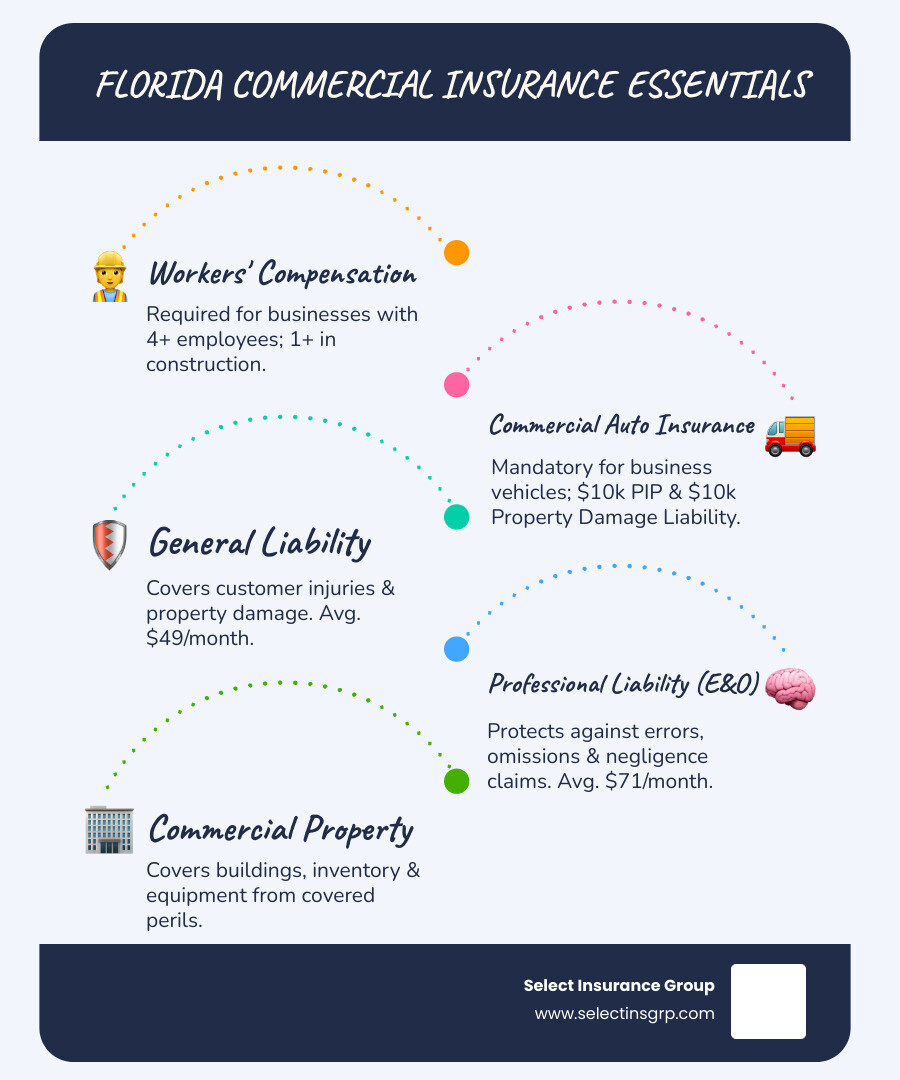
Required by Florida Law:
- Workers’ Compensation: Required for businesses with 4+ employees (1+ for construction)
- Commercial Auto Insurance: Required for all business-owned vehicles with minimum $10,000 PIP and $10,000 Property Damage Liability
Commonly Recommended Coverages:
- General Liability: Protects against customer injuries and property damage (avg. $49/month)
- Commercial Property: Covers buildings, inventory, and equipment
- Professional Liability (E&O): Protects against work errors and negligence claims (avg. $71/month)
- Business Owner’s Policy (BOP): Bundles property and liability coverage for cost savings
Florida is home to 2.8 million small businesses that employ 3.6 million people—representing 99.8% of all businesses in the state. For any business, having the right commercial insurance Florida isn’t just about legal compliance. It’s about protecting everything you’ve worked to build from hurricanes, lawsuits, accidents, and other risks unique to the Sunshine State.
The cost of coverage varies widely based on your industry, location, number of employees, and the types of vehicles or equipment you use. High-risk professions face higher premiums, while low-risk industries can often find affordable options, especially when bundling policies.
I’m D.J. Hearsey, founder and CEO of Select Insurance Group, with over three decades of experience helping businesses across the Southeast secure comprehensive commercial insurance Florida coverage. Our team specializes in navigating Florida’s unique insurance landscape, shopping across 20+ carriers to find you the right protection at competitive rates.
Florida’s Mandatory Business Insurance Requirements
Florida’s 2.8 million small businesses are the backbone of its economy. A crucial part of operating a business here is understanding the mandatory commercial insurance Florida requirements. Legal compliance isn’t just a formality; it’s a safeguard against hefty fines and legal repercussions. At Select Insurance Group, we help you steer these requirements to ensure your business is compliant and protected.
Florida state law is clear on certain types of coverage. Failing to meet these legal obligations can result in significant penalties, including fines, business closure, and even criminal charges in some cases. It’s not a risk worth taking.
For a comprehensive overview of state regulations, we often direct our clients to official resources like the Workers’ Compensation Requirements in Florida from the Florida Department of Financial Services. We also provide specialized guidance through our own Florida Workers Compensation resources.
Workers’ Compensation Insurance
Workers’ compensation insurance is a critical legal requirement in Florida. It protects your employees and your business from the financial strain of a workplace injury or illness by covering medical expenses, lost wages, and disability compensation.
The specific requirements for workers’ compensation insurance in Florida vary based on your industry and the number of employees you have:
- Non-construction businesses: If you operate a business outside of the construction industry, Florida law mandates that you carry workers’ compensation insurance if you have four or more employees, whether they are full-time or part-time.
- Construction industry: The rules are stricter for construction businesses. Even if you have just one employee, you are legally required to provide workers’ compensation coverage. This reflects the higher inherent risks associated with construction work.
These requirements are designed to create a safety net, making sure that if an employee gets hurt on the job, they can access necessary medical treatment and financial support without having to sue your business. For more detailed information on employee rights and benefits, the Workers’ Comp FAQs are an excellent resource.
Commercial Auto Insurance
If your business uses vehicles for work, commercial auto insurance Florida is required by law. This applies to owned, rented, or leased vehicles. You may also need a commercial policy to cover liabilities when employees use their personal vehicles for business tasks, as personal auto policies often won’t provide coverage.
Florida’s minimum coverage requirements for auto insurance, for both personal and commercial use, are:
- $10,000 in Personal Injury Protection (PIP)
- $10,000 in Property Damage Liability
While these are the minimums, they often provide limited protection. Businesses with significant assets or those that frequently transport goods or passengers should consider higher limits for better protection. You can find more details at Florida’s minimum requirements for auto liability coverage. To learn more about fleet coverage, visit our Florida Business Auto page.
Florida law has a specific definition for a commercial vehicle (e.g., gross weight over 26,001 pounds). However, the need for commercial auto insurance Florida applies to any vehicle used for business purposes if a personal policy would deny coverage for that use.
Key Types of Commercial Insurance for Florida Businesses
Beyond mandated policies, a robust commercial insurance Florida strategy includes other key coverages to protect your business from daily risks. We specialize in tailoring custom solutions for comprehensive risk management and asset protection, which is why we always discuss options like Florida General Liability with our clients.

General Liability Insurance
General Liability insurance is the bedrock of a solid commercial insurance Florida plan. It protects your business from financial losses due to common accidents, injuries, or property damage occurring on your premises or from your operations.
This essential policy typically covers:
- Bodily Injury: If a customer slips and falls in your store and gets injured, general liability can cover their medical expenses and related legal fees.
- Property Damage: Should your employee accidentally damage a client’s property while performing work, this coverage helps pay for repairs or replacement.
- Lawsuits: It also provides defense costs if your business is sued for libel, slander, or advertising injury.
Many commercial landlords in Florida require general liability coverage before offering a lease, and clients often demand proof of this insurance before signing contracts. With an average cost of around $49 per month, it’s a relatively affordable way to protect your business from potentially devastating claims.
Commercial Property Insurance
For businesses with a physical space, commercial property insurance Florida is essential. It protects your physical assets from perils like fire, theft, vandalism, and natural disasters. This coverage is paramount in Florida due to the risk of hurricanes.
Commercial property insurance typically covers:
- Buildings: The structure of your business premises.
- Inventory: The goods you have on hand for sale.
- Equipment: Machinery, tools, computers, and other essential business equipment.
- Business Income (Business Interruption Coverage): This crucial component reimburses your business for lost profits and fixed expenses if your operations are suspended due to covered property damage. It can even cover losses if civil authorities limit customer access after a disaster.
Standard policies often exclude flood damage, which requires a separate policy. Wind damage from hurricanes is usually covered but may have a higher, separate deductible. It’s vital to review your policy for exclusions and consider endorsements for full protection. For more details, the Commercial Property Insurance Overview is a great resource.
Professional Liability (E&O) Insurance
If your business provides professional services or advice, Errors and Omissions (E&O) insurance is a must-have. It protects you against claims of negligence, errors, or omissions that cause a client’s financial loss.
For example, if an accountant makes a mistake that costs a client money, or a consultant provides flawed advice, E&O insurance can cover the legal defense costs and any settlements or judgments. At an average cost of $71 per month, it’s a critical investment for service-based businesses.
Professions commonly needing E&O insurance in Florida include:
- Accountants and financial advisors
- Consultants (management, IT, marketing, etc.)
- Real estate agents and brokers
- Lawyers
- Architects and engineers
- Graphic designers and web developers
- Therapists and counselors
Business Owner’s Policy (BOP)
A Business Owner’s Policy (BOP) is a cost-effective solution for many small businesses. It bundles general liability and commercial property insurance into a single, convenient policy.
This integrated approach helps protect against many of the most common hazards of owning and operating a small business, such as property damage, theft, fire, and injury liability. By combining these coverages, businesses often find that a BOP offers a more affordable premium than purchasing each policy separately. It’s why we frequently recommend a BOP as a foundational piece of commercial insurance Florida for our small business clients.
Understanding the Costs of Commercial Insurance Florida
Business owners often ask, “How much does commercial insurance Florida cost?” The answer is complex, as the cost is highly individualized based on each business’s unique risks.
Factors Influencing Your Premiums
Several key factors influence the cost of your commercial insurance Florida premiums:
- Industry Type: High-risk professions, such as construction or roofing, naturally face higher premiums due to a greater likelihood of claims. Businesses are typically rated on exposures unique to their industry.
- Number of Employees: More employees can mean a higher risk for workers’ compensation claims and general liability exposures.
- Claims History: A history of frequent or large claims will likely result in higher premiums.
- Vehicle Types and Usage: For commercial auto, the type of vehicles (e.g., a delivery van vs. a semi-truck), their usage, and the driving records of your employees significantly impact costs. You can learn more about how these factors affect rates on our Average Truck Insurance Cost page.
- Geographic Location: Florida’s diverse geography plays a significant role. A business located on the coast near Miami, highly susceptible to hurricanes, will have different insurance rates than one inland near Gainesville, which faces fewer severe weather risks.
- Policy Limits and Deductibles: Higher coverage limits provide more protection but increase premiums. Conversely, choosing a higher deductible can lower your premium, but you’ll pay more out-of-pocket if a claim occurs.
For instance, while general liability might average $49 per month and professional liability around $71 per month, these are just averages. A high-risk construction business in a coastal area will see significantly different rates than a consulting firm in a less vulnerable region.
How to Save on Your Commercial Insurance Florida Policy
While cost is a factor, compromising on essential coverage isn’t a strategy we recommend. However, there are smart ways small business owners in Florida can save money on their commercial insurance Florida without sacrificing vital protection:
- Bundling Policies: As we discussed with the Business Owner’s Policy (BOP), combining general liability and commercial property insurance often results in a discount compared to purchasing them separately. We explore bundling options with all our clients.
- Shopping Around: This is one of the best ways to find an affordable option. We leverage our network of over 40 carriers to compare quotes and find the most competitive rates for your specific needs.
- Increasing Deductibles: If your business has a healthy emergency fund, opting for a higher deductible can reduce your monthly or annual premium. Just ensure you can comfortably cover the deductible amount if a claim arises.
- Implementing Safety Programs: A proactive approach to workplace safety can reduce claims and, over time, lead to lower workers’ compensation premiums.
- Annual Payment Discounts: Many insurers offer a discount if you pay your premium annually rather than monthly.
[TABLE] Comparing Commercial vs. Personal Auto Insurance
It’s a common misconception that a personal auto policy can cover a vehicle used for business. However, there’s a significant difference between personal and commercial auto insurance Florida. Understanding this distinction is crucial to ensure your business vehicles are adequately protected.
| Feature | Personal Auto Insurance | Commercial Auto Insurance |
|---|---|---|
| Coverage Scope | Primarily covers personal use of a vehicle. | Covers vehicles used for job duties and business operations. |
| Liability Limits | Typically lower limits, designed for individual risks. | Generally offers higher liability limits, reflecting greater business risks. |
| Vehicle Types | Standard passenger cars, SUVs, and personal trucks. | Company cars, vans, trucks, box trucks, semi-trucks, and fleets. |
| Permitted Use | Commuting, personal errands, recreational driving. | Deliveries, client visits, transporting equipment/goods, service calls. |
| Policy Ownership | Owned by an individual. | Owned by a business entity (sole proprietorship, LLC, corporation). |
| Exclusions | Often excludes any business-related use; claims for business use may be denied. | Specifically designed to cover business use; may include Hired and Non-Owned Auto coverage for employee personal vehicles used for work. |
A personal auto policy will almost certainly deny a claim if the vehicle was being used for business purposes at the time of an accident. This means if your employee is driving their personal car to a client meeting and gets into a fender bender, their personal policy might not cover it, leaving your business exposed. That’s why considering Hired and Non-Owned Auto (HNOA) insurance is also recommended when employees use their personal vehicles for work.
Industry-Specific and High-Risk Coverage in Florida
Florida’s diverse economy presents unique risks for every industry. A one-size-fits-all approach doesn’t work for commercial insurance Florida. At Select Insurance Group, we analyze your industry’s niche risks to find specialized policies that protect you, including complex areas like Owner Operator Semi Truck Insurance.
Top Industries and Their Insurance Needs
Florida’s top industries are the backbone of its economy, but each comes with its own unique insurance landscape:
- Construction: A high-risk industry requiring more than mandatory workers’ comp. Contractors need robust general liability, commercial auto, and often Builder’s Risk policies. Design-build firms may also need professional liability. For licensing details, see the Florida general contractor license and insurance requirements.
- Hospitality (Restaurants/Hotels): These businesses face risks from customer injuries (slip and fall), foodborne illnesses, property damage, and liquor liability. General liability, commercial property (especially for hurricane damage), and business interruption are crucial.
- Retail: Retailers need general liability to cover customer injuries, commercial property for inventory and storefronts, and potentially cyber insurance if they handle customer data or online sales.
- Real Estate: Agents, brokers, and property managers require professional liability (E&O) to protect against claims of negligence or errors in their advice or transactions. General liability and commercial auto are also common.
- Manufacturing: Manufacturers need coverage for their facilities, machinery, products liability (if a product causes harm), and workers’ compensation for their production teams.
These are just a few examples; we work closely with clients to identify all potential exposures and tailor a comprehensive commercial insurance Florida package.
Navigating High-Hazard Risks
High-hazard or unusual businesses may struggle to get coverage from standard “admitted” insurers. Admitted carriers are licensed by the state, use state-approved rates, and are backed by the state’s guaranty fund, offering an extra layer of protection.
For risks admitted insurers won’t cover, “Surplus Lines (SL)” insurers are an option. These non-admitted carriers have more flexibility in rates and coverage for unique risks (e.g., fireworks businesses, high-rise construction). They are not backed by the state guaranty fund but must be eligible by the Florida Office of Insurance Regulation (FLOIR).
If your business is struggling to find coverage through traditional channels, don’t despair. Surplus Lines insurers are specifically designed for these situations. We can help you explore these options and connect you with reputable SL companies. You can even find a list of SL companies via the FLOIR SL Company Search.
Special Considerations: Cyber, Builder’s Risk, and Policy Notices
Florida businesses face several other critical considerations when it comes to their commercial insurance Florida portfolio:
- Cyber Insurance: Data breaches are a significant threat. Hackers are three times more likely to target small businesses, often because they have fewer resources to combat cyber threats. Florida’s data breach laws require businesses to report security breaches to affected residents, and the costs can escalate quickly, including notification expenses, legal fees, and fines. Cyber insurance helps mitigate these financial impacts, protecting your business’s reputation and bottom line.
- Builder’s Risk Policies: For construction projects, a Builder’s Risk policy is essential. This coverage protects buildings under construction from damage due to fire, vandalism, theft, and weather events. Regarding wind and rain damage in Florida:
- Builder’s Risk policies are typically “named peril” policies, meaning they only cover perils specifically listed.
- Wind damage should generally be covered, but often with specific conditions, such as requiring the construction to be at a certain stage (e.g., 50% or 75% completion) before wind coverage applies.
- Rain, generally, is not a named peril. However, limited coverage for materials located at the job site damaged by rain might be included by endorsement. Always review your policy’s specific provisions.
- Policy Cancellation/Non-Renewal Notice Requirements: Understanding the rules for policy cancellation or non-renewal is vital. Florida law (specifically sections 627.4133 and 626.9201, F.S.) dictates strict notice requirements for commercial property insurance policies. These rules vary depending on whether the insurer is “admitted” or “surplus lines” and the policy’s duration. For instance, admitted insurers typically require 45 days’ notice for non-renewal or cancellation after 60 days, while surplus lines insurers have similar timelines but with specific requirements to state reasons. Furthermore, during declared emergencies (like hurricanes), there are often prohibitions on cancellation or non-renewal of commercial residential property policies for a period after the property has been repaired.
- Citizens Property Insurance Corporation: For businesses struggling to find coverage in the private market, Citizens Property Insurance Corporation serves as Florida’s insurer of last resort. They offer commercial residential policies (for apartment buildings, condo associations) and commercial nonresidential policies. These can be multiperil or wind-only, the latter being critical in hurricane-prone areas, but note that Citizens’ commercial policies generally exclude liability coverage.
Frequently Asked Questions about Florida Commercial Insurance
We know that navigating commercial insurance Florida can bring up a lot of questions. Here are some of the most common ones we encounter, along with clear answers to help you understand your coverage better.
What does Florida commercial auto insurance typically cover?
Commercial auto insurance Florida is designed to protect your business vehicles and operations. It typically includes a range of coverages to address various scenarios:
- Bodily Injury Liability: Covers medical expenses and legal fees if your business vehicle causes injury or death to another person.
- Property Damage Liability: Pays for damages to another person’s property if your business vehicle is at fault in an accident.
- Collision Coverage: Covers damage to your own business vehicle resulting from a collision with another vehicle or object, regardless of fault.
- Comprehensive Coverage: Protects your business vehicle from non-collision-related incidents like theft, vandalism, fire, or damage from natural disasters (e.g., hurricane wind, hail).
- Uninsured/Underinsured Motorist Coverage: Protects your business and its drivers if they are involved in an accident with a driver who has no insurance or insufficient insurance to cover the damages.
- Hired and Non-Owned Auto (HNOA) Coverage: An important addition, this extends liability coverage for vehicles your business hires, leases, or employees use for work purposes but are not owned by the business itself. This is crucial because personal auto policies often exclude business use.
What types of businesses commonly need commercial auto insurance in Florida?
Any Florida business using vehicles for work, whether company-owned or not, likely needs commercial auto insurance Florida. This includes industries like:
- Contractors: Plumbers, electricians, landscapers, roofers, general contractors, and painters who transport tools, equipment, and materials to job sites.
- Delivery Services: Restaurants, florists, courier services, and any business that delivers goods to customers.
- Retailers: Businesses that use vehicles for inventory transport, customer deliveries, or store-to-store transfers.
- Service Businesses: HVAC technicians, pest control companies, cleaning services, and mobile repair technicians.
- Food Trucks and Catering Businesses: These often operate specialized vehicles that require specific commercial auto coverage.
- Real Estate Agents: While they might use personal vehicles, the frequent business use for showings and client meetings often necessitates commercial auto coverage or an HNOA policy.
- Any business where employees use their personal vehicles for work-related tasks: Even if you don’t own a fleet, if your staff regularly drives for business, you need to consider this coverage.
What is covered under a Builder’s Risk policy in Florida regarding wind and rain?
A Builder’s Risk policy is specialized commercial insurance Florida for construction projects. Understanding its coverage for wind and rain is critical in a hurricane-prone state:
- Named Peril Policies: Builder’s Risk policies are typically “named peril” policies. This means they only cover damages caused by perils explicitly listed in the policy.
- Wind Damage Coverage: Generally, wind damage is a covered peril under a Builder’s Risk policy. However, there are often specific conditions and exclusions. For example, some policies require the construction to be at a certain stage of completion (e.g., 50% or 75%) before full wind coverage applies. Hurricane deductibles, which are often a percentage of the insured value, are also common.
- Rain Damage Coverage: Rain is generally not a named peril in standard Builder’s Risk contracts. This means damage caused directly by rain might not be covered. However, limited coverage for materials located at the job site that are damaged by rain can sometimes be added by endorsement. This might protect building materials that are exposed before the structure is enclosed.
- Policy-Specific Provisions: It’s crucial to review each Builder’s Risk policy carefully. The exact scope of wind and rain coverage, including deductibles, exclusions, and conditions, will vary significantly between policies and carriers.
We always advise our construction clients to have a thorough discussion about these nuances to ensure their projects are adequately protected against Florida’s unique weather challenges.
Your Partner for Comprehensive Florida Commercial Insurance
Florida’s dynamic business landscape offers incredible opportunities, but it also presents a unique set of risks that demand comprehensive protection. From the mandatory workers’ compensation and commercial auto policies to essential coverages like general liability, commercial property, and professional liability, navigating commercial insurance Florida can feel overwhelming.
At Select Insurance Group, we understand the complexities and the critical need to protect your investment. With over 30 years of experience, we pride ourselves on being your expert guide and trusted partner. We don’t just sell policies; we leverage our deep understanding of Florida’s insurance market and our relationships with over 40 carriers to shop for the best coverage at competitive rates, custom specifically to your business’s needs.
We believe in providing superior customer service, offering clear explanations, and simplifying the process so you can focus on what you do best: running your business. Let us help you build a robust insurance portfolio that safeguards your hard work and secures your future.
Ready to protect your Florida business? Get a Quote today and experience the Select Insurance Group difference.