
What You Need to Know About Deductibles Motorcycle Insurance Cost
Understanding deductibles motorcycle insurance cost can save you hundreds of dollars a year — or cost you big if you get it wrong.
Here’s the short version:
| Deductible Amount | Effect on Premium | Best For |
|---|---|---|
| $250 | Higher monthly premium | Riders who want low out-of-pocket costs after a claim |
| $500 | Moderate premium savings | Most riders — good balance of cost and protection |
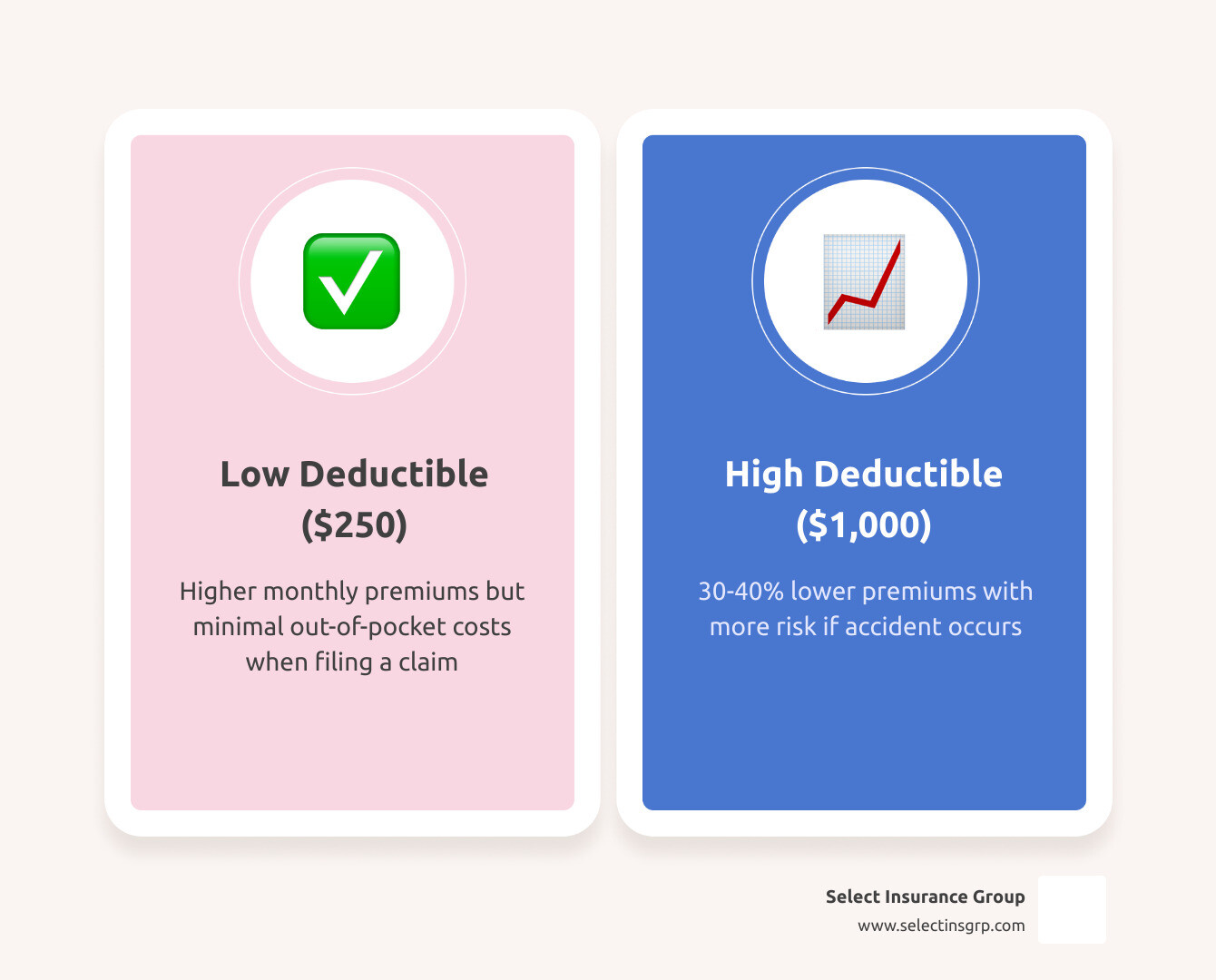
| $1,000 | 30–40% lower premium | Riders with savings to cover costs if something goes wrong |
Key facts at a glance:
- A deductible is what you pay out of pocket before your insurance kicks in on a claim
- Deductibles apply to collision and comprehensive coverage only — not liability
- Raising your deductible from $250 to $1,000 can lower your collision and comprehensive premiums by 30% to 40%
- The most common deductible amounts are $500 and $1,000
- You should never choose a deductible higher than what you can afford to pay right now
The tradeoff is simple: a higher deductible means lower monthly payments, but more money out of your pocket if you ever file a claim. Getting that balance right is what this guide is all about.
One real-world example that shows why this matters: a new rider in British Columbia paid $1,859 per year for an old 1980s Honda — partly because they chose a $300 deductible on a bike worth only $2,000. Community members quickly pointed out the math didn’t add up, and that dropping or adjusting coverage could save them around $500 a year.
That kind of decision — choosing a deductible without thinking through the full cost picture — is exactly what catches riders off guard.
I’m D.J. Hearsey, founder and CEO of Select Insurance Group, and with over three decades of experience helping Southeast US riders navigate deductibles motorcycle insurance cost decisions, I’ve seen how a single deductible choice can make or break a policy’s value. In this guide, I’ll walk you through everything you need to make the smartest call for your budget and riding style.
Understanding Your Motorcycle Insurance Deductible
When we talk about a deductible, we are talking about your “skin in the game.” It is the specific dollar amount you agree to pay toward repairs or the replacement of your bike before your insurance provider cuts a check. Think of it as a form of risk-sharing between you and us.
In motorcycle insurance, deductibles generally apply to two main types of “physical damage” coverage:
- Collision Coverage: This kicks in if you hit another vehicle, a guardrail, or even if you lay the bike down on the pavement. If you have a $500 deductible and suffer $2,000 in damage, you pay the first $500, and the policy covers the remaining $1,500.
- Comprehensive Coverage: This covers “acts of God” or events out of your control, such as theft, fire, vandalism, or hitting a deer. Since motorcycles are unfortunately high-theft items, this coverage is vital.
It is a common misconception that deductibles apply to everything. In reality, liability insurance does not have a deductible. If you are at fault in an accident and cause $20,000 in bodily injury to someone else, your insurance pays out up to your policy limits without you having to pay a deductible first. However, if the damages exceed your limits—say you have $25,000 in coverage but cause $40,000 in damage—you are on the hook for that $15,000 difference.
Understanding The Costs, Limits and Deductibles of Motorcycle Insurance is the first step toward building a policy that actually protects your wallet. By choosing a deductible, you are essentially telling the insurer how much of the financial risk you are willing to handle yourself in exchange for a lower monthly bill.
How Deductibles Motorcycle Insurance Cost and Premiums Interact
The relationship between your deductible and your premium is what we call an “inverse relationship.” When one goes up, the other goes down.
Insurance companies love it when you choose a higher deductible because it does two things: it reduces the amount they have to pay on every claim, and it discourages you from filing “small” claims (like a $400 repair when you have a $500 deductible). Because you are taking on more risk, the company rewards you with a lower premium.
How much can you actually save? The data shows some pretty impressive numbers:
- Increasing your deductible from $250 to $1,000 can slash your collision and comprehensive premiums by 30% to 40%.
- Even a jump from $500 to $1,000 can lower full coverage premiums by roughly 20% to 40%.
To help you visualize the potential savings, look at this comparison table based on average industry trends:
| Deductible Level | Estimated Annual Premium (Full Coverage) | Estimated Savings |
|---|---|---|
| $250 | $600 | Base Rate |
| $500 | $480 | 20% Savings |
| $1,000 | $390 | 35% Savings |
| $2,000 | $300 | 50% Savings |
Note: These are estimates. Your actual deductibles motorcycle insurance cost will vary based on your age, bike type, and location.
While the savings are tempting, you have to do the “break-even” math. If raising your deductible from $500 to $1,000 saves you $100 a year, it will take you five years of claim-free riding to “earn back” that extra $500 you’d have to pay if you crashed tomorrow. If you’re a safe rider with a secure garage, that’s often a bet worth taking.
Choosing the Right Deductible for Your Riding Style

Choosing a deductible isn’t just about the math; it’s about your lifestyle and your bike. We always tell our clients in Georgia and the Carolinas to look at three specific factors:
1. Your Emergency Fund The “golden rule” of insurance is never to choose a deductible higher than the cash you have sitting in your bank account right now. If you choose a $1,000 deductible but only have $200 in savings, an accident won’t just ruin your bike—it will leave you stranded and unable to repair it.
2. The Value of Your Bike If you are riding a brand-new $25,000 touring bike, a $1,000 deductible is a drop in the bucket compared to the total value. However, if you’re on an older bike worth $2,500, a $1,000 deductible means the insurance company is only really covering $1,500 of the value. At that point, you might be better off with a lower deductible or even dropping collision coverage entirely and “self-insuring.”
3. Where and How You Ride Do you live in a high-theft urban area? If so, you might want a lower comprehensive deductible. Are you a weekend cruiser or a daily commuter? The National Highway Traffic Safety Administration reports on crash injuries remind us that 80% of motorcycle accidents result in injury. While deductibles don’t apply to medical payments (MedPay), having a high deductible on your bike during a time when you might also be facing medical bills can create a massive financial strain.
For more tailored advice, you can check out our More info about motorcycle insurance guides to see how different bikes and riders stack up.
Impact of High Deductibles Motorcycle Insurance Cost on Full Coverage
“Full coverage” is a bit of a misnomer in the industry, but it generally refers to a policy that includes Liability, Collision, and Comprehensive. If you have a loan on your motorcycle, your lender will almost certainly require you to carry full coverage.
Lenders also usually place a “cap” on how high your deductible can be. Most banks won’t let you go above a $500 or $1,000 deductible because they want to ensure the bike (which is their collateral) can actually be repaired if it’s damaged.
When considering Full Coverage Motorcycle Insurance details, keep in mind that most policies pay out based on Actual Cash Value (ACV). This means if your bike is totaled, the insurer pays you what the bike was worth at the time of the crash (minus your deductible), not what you paid for it. If you have a high deductible on a depreciating asset, you might find yourself in a “gap” where you owe the bank more than the insurance company pays out.
For riders in the Old Dominion, we have specific resources regarding More info about Virginia motorcycle insurance that cover state-specific requirements and lender expectations.
Strategies to Lower Your Total Policy Price
Adjusting your deductibles motorcycle insurance cost is one of the fastest ways to lower your bill, but it isn’t the only way. We recommend a “multi-pronged” approach to keep your premiums low without taking on massive out-of-pocket risks.
- Bundle Your Policies: This is often the biggest winner. By placing your motorcycle, auto, and homeowners insurance with the same carrier, you can see discounts of 15% to 25%.
- Maintain a Clean Record: Your driving history is the primary factor in your base rate. Avoiding speeding tickets and at-fault accidents keeps you in the “preferred” tier of riders.
- Install Anti-Theft Devices: Since comprehensive claims are often for theft, insurers love to see GPS trackers, alarms, or even high-quality disc locks.
- Use a Lay-Up Policy: In states like Virginia or North Carolina where you might not ride during the winter, a “lay-up” policy maintains your comprehensive coverage (for fire/theft in the garage) but pauses your collision and liability coverage while the bike is in storage.
- Take a Safety Course: Completing an approved list of motorcycle courses not only makes you a better rider but can trigger a permanent discount on your policy.
Balancing Your Deductibles Motorcycle Insurance Cost with Safety Discounts
The goal is to find the “sweet spot” where your discounts and your deductible work together to create an affordable, robust policy.
Common discounts we look for at Select Insurance Group include:
- Safety Course Discount: 5% to 15% off for graduates of the Motorcycle Safety Foundation (MSF) courses.
- Multi-Vehicle Discount: If you have more than one bike in the garage.
- Homeownership Discount: Insurers view homeowners as more stable risks.
- Paid-in-Full Discount: Paying your annual premium upfront instead of monthly can save you 5% to 10% in “installment fees.”
If you’re riding in the Palmetto State, check out More info about South Carolina motorcycle insurance for a deeper dive into the specific discounts available locally.
Frequently Asked Questions about Motorcycle Insurance
Does my deductible apply if I am not at fault in an accident?
This is a tricky one. Technically, yes, if you use your own collision coverage to fix your bike quickly, you will have to pay your deductible. However, your insurance company will then go through a process called subrogation. They will chase the at-fault party’s insurance to get their money back. Once they are successful, they will usually reimburse you for your deductible. If the other person’s fault is clear and their insurance accepts liability immediately, you might be able to get your bike fixed through their property damage liability, in which case you pay $0.
What happens if I cannot afford my deductible after an accident?
If you can’t pay the shop your $1,000 deductible, they generally won’t release the bike to you. This can lead to storage fees and mechanic liens. If the bike is a total loss, the insurance company simply subtracts the deductible from your payout. If your bike was worth $5,000 and you have a $1,000 deductible, you just get a check for $4,000. To avoid this, we recommend setting up a dedicated “deductible fund” in a high-yield savings account.
Are deductibles required for liability-only motorcycle policies?
No. Liability-only policies—which only cover the damage you do to others—do not have deductibles. This is why liability-only is so much cheaper. However, if you choose this route, you are essentially choosing a “100% deductible” for your own bike. If it’s stolen or you crash it, you get nothing from the insurance company. This is usually only recommended for bikes worth less than $2,000.
Conclusion
Navigating deductibles motorcycle insurance cost doesn’t have to be a headache. The key is to be honest about your finances: if you have the savings to cover a $1,000 surprise, take the premium discount and run with it. If things are tight, paying a little more each month for a $250 deductible provides a valuable safety net.
At Select Insurance Group, we have over 30 years of experience helping riders across Florida, Georgia, Virginia, and the Carolinas find that perfect balance. We don’t just work for one company; we shop over 40 different carriers to find the one that rewards your specific riding style and deductible choice.
Whether you’re cruising the Blue Ridge Parkway or commuting through Atlanta, we’re here to make sure your coverage is as solid as your ride. Get a quote for the cheapest motorcycle insurance today and let us do the heavy lifting for you. Ride safe!