Why Understanding North Carolina’s Insurance System Matters After an Accident
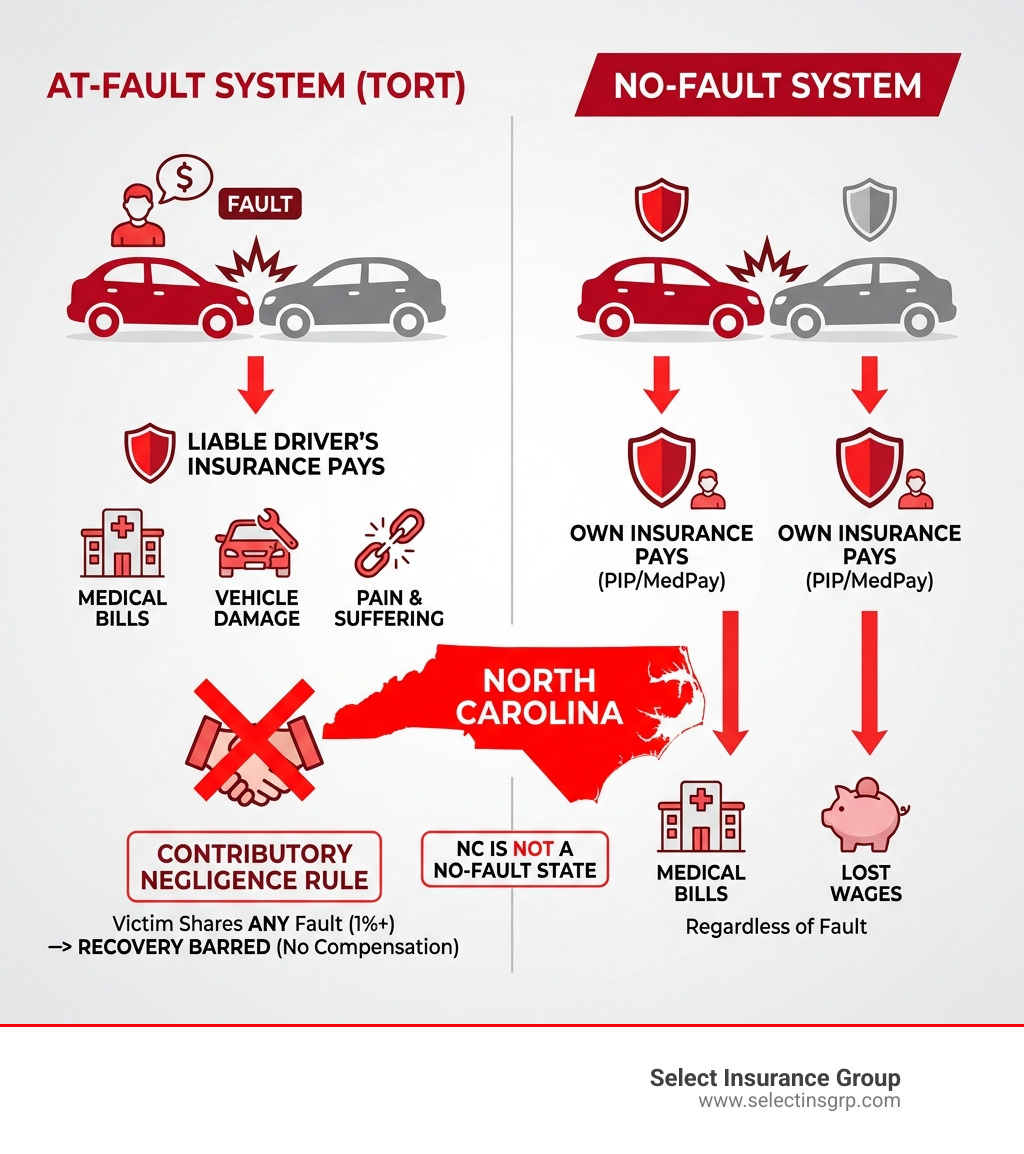
Is North Carolina a no fault auto insurance state? No. North Carolina operates under an at-fault (or tort) insurance system, meaning the driver who causes an accident is financially responsible for all resulting damages, including medical expenses, property damage, lost wages, and pain and suffering.
Key Facts About North Carolina’s Auto Insurance System:
- System Type: At-fault (tort-based), not no-fault
- Who Pays: The at-fault driver’s liability insurance covers damages to other parties
- Contributory Negligence Rule: If you share even 1% of fault, you cannot recover any compensation
- Minimum Required Coverage: $30,000 per person / $60,000 per accident for bodily injury; $25,000 for property damage
- Uninsured Motorist Coverage: Required by state law
- PIP Insurance: Not required (optional MedPay available instead)
After an accident, it’s natural to worry about what happens next—especially when you’re facing medical bills, vehicle repairs, or time off work. The confusion often begins with understanding who pays for what under North Carolina law. Unlike no-fault states where your own insurance covers your medical expenses regardless of who caused the crash, North Carolina requires you to prove the other driver was at fault before you can recover a single dollar.
This creates both opportunity and risk. If the other driver was clearly negligent, you can pursue full compensation for all your losses. But North Carolina’s harsh contributory negligence rule means that if you share even the smallest portion of blame—say, driving 5 mph over the speed limit when another driver ran a red light—you may be barred from recovering anything at all.
Understanding these rules before you file a claim or speak with insurance adjusters can make the difference between full compensation and walking away with nothing.
I’m D.J. Hearsey, founder and CEO of Select Insurance Group, and over three decades in the insurance industry across the Southeast, I’ve helped countless drivers navigate the complexities of is North Carolina a no fault auto insurance state and what that means for their coverage and claims. My goal is to ensure you understand exactly how North Carolina’s at-fault system works so you can protect yourself with the right coverage and make informed decisions after an accident.
Basic is north carolina a no fault auto insurance state glossary:
Is North Carolina a No Fault Auto Insurance State?

When we talk about whether is north carolina a no fault auto insurance state, we are looking at how the law assigns financial responsibility. In a “no-fault” state, your own insurance company pays for your medical bills and lost wages through Personal Injury Protection (PIP), no matter who caused the fender bender. North Carolina, however, is a traditional at-fault or “tort” state.
In our state’s tort system, the person who made the mistake—whether they were texting, speeding, or failing to yield—is the one who has to pay. This means that if you are the victim, you don’t automatically get a check from your own insurer for your injuries. Instead, you must seek compensation from the other driver’s insurance company.
This system relies heavily on the concepts of liability and negligence. To get paid, you have to prove that the other person was negligent (meaning they failed to use a reasonable standard of care on the road) and that their negligence directly caused your injuries.
For more detailed information, you can check out our guide on North Carolina Auto Insurance or read the official North Carolina Car Accident Laws. Being in an at-fault state means you have the right to sue for the full extent of your damages, but it also places the burden of proof squarely on your shoulders.
Why the answer to “is north carolina a no fault auto insurance state” impacts your recovery
Because the answer is a resounding “No,” your path to recovery is much more complex than it would be in a no-fault state like Florida or New York. Here is why this matters:
- Recovery Barriers: You cannot simply file a claim and wait for a check. You must actively prove the other driver’s fault.
- Insurance Adjuster Tactics: Since the other driver’s insurance company is on the hook for the money, their adjusters are highly motivated to find reasons not to pay you. They will look for any sign that you contributed to the accident.
- Legal Burden of Proof: You need evidence—police reports, witness statements, and photos—to build a case.
- Settlement Negotiations: Most cases are settled through negotiation, but if the insurance company refuses to acknowledge their driver’s fault, you may have to head to court.
Understanding the Pure Contributory Negligence Rule
This is where North Carolina laws get a bit “old school,” and not in a fun, vintage way. North Carolina is one of only five jurisdictions in the United States that still uses a rule called pure contributory negligence.
In most other states, if you are 10% at fault for an accident, you can still recover 90% of your damages. That is called “comparative negligence.” But here in the Old North State, if you are found to be even 1% at fault, you are legally barred from recovering a single penny from the other driver.
Imagine this: A driver is barreling down the road at 80 mph, blows through a stop sign, and hits you. However, you were driving 3 mph over the speed limit. An insurance adjuster or a jury could argue that your speeding “contributed” to the accident. Under contributory negligence, that 1% of fault could result in you receiving zero compensation for your $50,000 medical bill.
The “Last Clear Chance” Doctrine
There is one small “safety valve” in this strict system known as the Last Clear Chance Doctrine. If you were negligent, but the other driver had the “last clear chance” to avoid the collision and failed to do so, you might still be able to recover damages. However, proving this in court is notoriously difficult and usually requires a very skilled legal hand.
MedPay and PIP: Optional coverages since “is north carolina a no fault auto insurance state” is not the law
Since North Carolina doesn’t require Personal Injury Protection (PIP), many drivers find themselves in a tough spot if an accident happens and fault is disputed. To protect yourself, we often recommend adding Medical Payments (MedPay) coverage to your policy.
MedPay is North Carolina’s version of no-fault coverage. It is optional, but it’s a lifesaver. It typically covers:
- Doctor visits
- Ambulance fees
- X-rays and surgeries
- Funeral expenses
The beauty of MedPay is that it pays out regardless of fault. Even if you were 100% responsible for the crash, MedPay will cover your medical bills up to your policy limit (usually between $1,000 and $10,000). This ensures you have immediate access to medical care while the insurance companies spend months arguing over who is at fault.
If you’re wondering about costs, you can see where in North Carolina is Auto Insurance the Least Expensive to help balance your budget while adding these important protections.
North Carolina Minimum Auto Insurance Requirements
To legally drive in North Carolina, you must carry liability insurance. This insurance doesn’t cover you; it covers the other person if you cause an accident. The state mandates specific minimum limits, often referred to as “30/60/25.”
| Coverage Type | NC Minimum Requirement | What It Covers |
|---|---|---|
| Bodily Injury (Per Person) | $30,000 | Medical bills/lost wages for one injured person. |
| Bodily Injury (Per Accident) | $60,000 | The total amount paid for all injuries in one crash. |
| Property Damage | $25,000 | Repairs to the other driver’s car or property. |
| Uninsured Motorist (UM) | Matches Liability | Covers you if hit by a driver with no insurance. |
While these are the minimums, we often advise our clients at Select Insurance Group to consider higher limits. If you cause an accident that totals a $60,000 SUV, a $25,000 property damage limit will leave you personally responsible for the remaining $35,000.
Additionally, North Carolina law requires uninsured motorist (UM) coverage. This is vital because it protects you if you’re involved in a hit-and-run or hit by someone driving illegally without insurance. You can also opt for Underinsured Motorist (UIM) coverage, which kicks in if the at-fault driver’s insurance isn’t enough to cover your total bills. To see how these requirements affect your wallet, read our analysis on Is Auto Insurance Less Expensive in North Carolina.
How to File a Car Accident Claim and Prove Fault
Since you now know that the answer to is north carolina a no fault auto insurance state is “No,” you understand that proving fault is everything. If you are involved in a crash, the “how-to” of your recovery starts at the scene.
Steps to Take Immediately:
- Safety First: Move to a safe area and check for injuries. Call 911 immediately if anyone is hurt.
- Call the Police: In NC, you must report any accident involving injury, death, or property damage over $1,000. A police report is the single most important piece of evidence for your claim.
- Gather Evidence:
- Photos/Video: Capture vehicle positions, skid marks, traffic signs, and weather conditions.
- Witnesses: Get names and phone numbers. Their neutral accounts can debunk an “it was his fault” argument from the other driver.
- Dashcam Footage: If you have it, save it!
- Exchange Info: Get the other driver’s name, address, and insurance policy number.
- Watch Your Words: Do not apologize or admit fault. Even a polite “I’m sorry, I didn’t see you” can be used as evidence of contributory negligence to bar your claim.
Once you leave the scene, notify your insurance company. We work with many NC Auto Insurance Companies and can tell you that prompt notification is key to a smooth process.
Post-Accident Procedures and Legal Deadlines
Time is not on your side after a car accident. North Carolina has strict statutes of limitations that dictate how long you have to take legal action.
- Personal Injury: You have three years after the date of your injury to file a lawsuit.
- Property Damage: Also three years from the date of the accident.
- Wrongful Death: If a loved one passes away due to an accident, the family has only two years from the date of death to file a claim.
Handling Vehicle Damage and Total Losses
If your car is damaged, an insurance adjuster will evaluate the repair costs. In North Carolina, a vehicle is considered a “total loss” if the cost of repairs plus the salvage value is equal to or greater than 75% of the car’s pre-accident Actual Cash Value (ACV).
If your car is totaled, the insurance company will pay you the ACV (what the car was worth right before the crash), not what you paid for it or what it costs to buy a brand-new one. For those in coastal areas, check out Auto Insurance Wilmington NC for specific regional advice on vehicle protection. You can also learn more about Salvaged and Abandoned Vehicles in North Carolina through the DMV.
Frequently Asked Questions about NC Accident Laws
Can you sue for pain and suffering in North Carolina?
Yes! Because North Carolina is an at-fault state, you are not limited to just medical bills. You can seek “non-economic damages” for pain and suffering, emotional distress, and loss of enjoyment of life. There is no set formula for this; it usually depends on the severity of the injury and the impact on your daily life.
What happens if I share any fault in a North Carolina car accident?
As we discussed with the 1% rule, sharing any fault usually means you get nothing from the other driver’s insurance. This is why it is critical to have an insurance agent who helps you set up the right “first-party” coverages (like Collision and MedPay) so you aren’t left stranded if the fault is shared.
Is PIP insurance required in North Carolina?
No, PIP is not required. North Carolina uses MedPay instead. While PIP often covers things like lost wages and childcare, MedPay is strictly for medical bills and funeral expenses. If you want coverage for lost wages regardless of fault, you would need to look into a separate disability insurance policy.
Conclusion
Navigating the aftermath of a car accident in North Carolina can feel like walking through a legal minefield. Between the at-fault system and the unforgiving contributory negligence laws, the stakes are incredibly high. Knowing that is north carolina a no fault auto insurance state is “No” is just the first step—protecting yourself with the right policy is the next.
At Select Insurance Group, we have over 30 years of experience helping drivers across the Carolinas find the perfect balance of protection and value. We shop over 40 different carriers to make sure you have the liability limits you need and the optional coverages (like MedPay and UM/UIM) that keep you safe when the unexpected happens.
Don’t wait until after an accident to find out if your coverage is sufficient. Get a quote for North Carolina Auto Insurance today and let our team of experts give you the peace of mind you deserve on the road.