
Why Commercial Insurance Is the Safety Net Every Business Needs
Commercial insurance is a broad set of business policies that protect your company from financial losses caused by property damage, lawsuits, employee injuries, theft, and more.
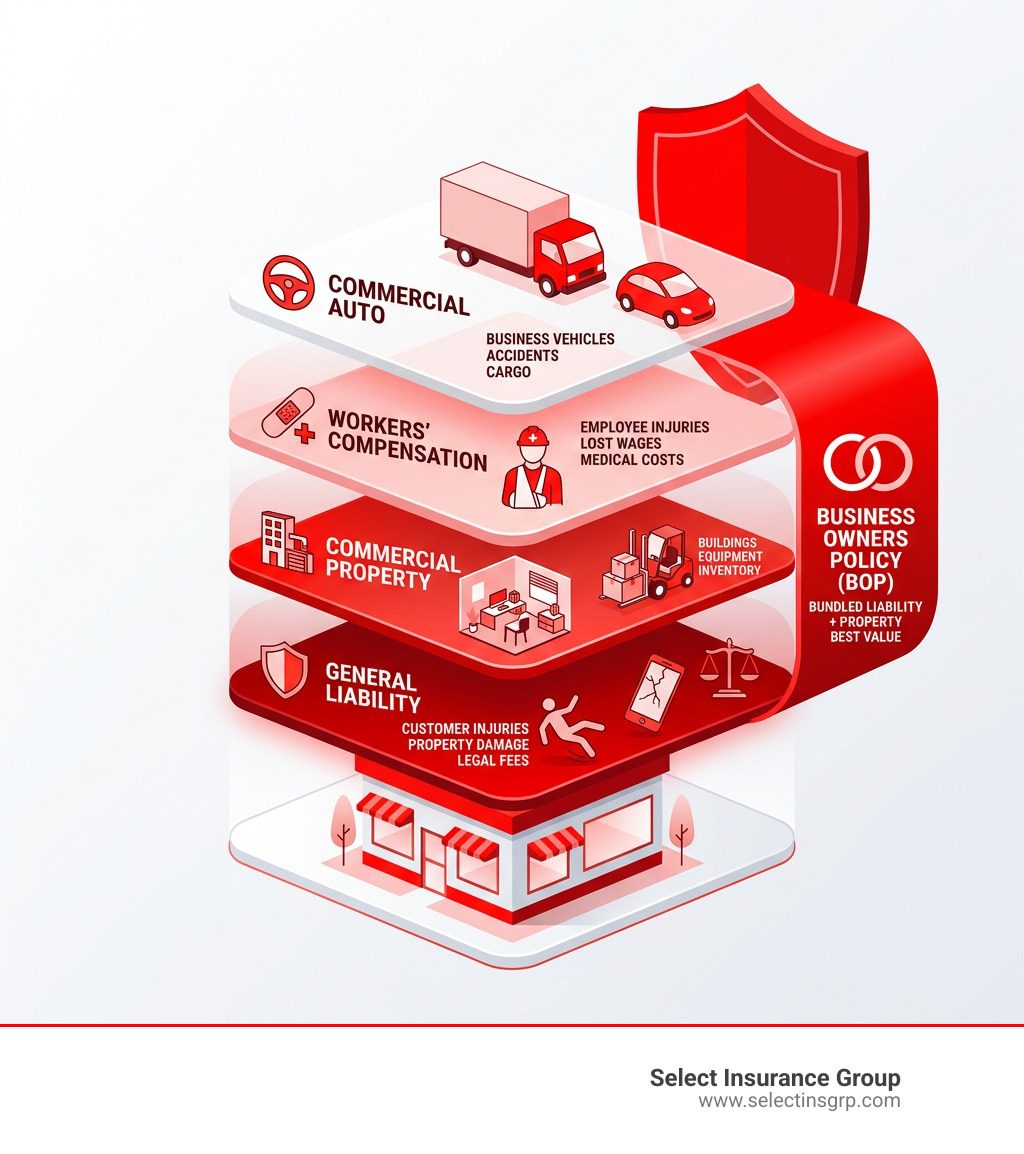
If you’re comparing business insurance quotes, here’s a quick-reference breakdown to get you started:
| Coverage Type | What It Protects |
|---|---|
| General Liability | Customer injuries, property damage, legal fees |
| Commercial Property | Buildings, equipment, inventory |
| Workers’ Compensation | Employee injuries, lost wages, medical costs |
| Commercial Auto | Business vehicles, accidents, cargo |
| Professional Liability | Negligence claims, errors, omissions |
| Business Owners Policy (BOP) | Bundled general liability + property (best value for small businesses) |
Running a business means taking risks every single day. A customer slips in your store. A fire destroys your equipment. A lawsuit lands on your desk out of nowhere. Without the right coverage, any one of these events could wipe out everything you’ve built.
The stakes are real. A single major claim — with no insurance in place — can push a small business into bankruptcy. That’s not a worst-case scenario. It happens constantly.
The good news? The right commercial policy can be affordable, especially when you compare quotes across multiple carriers.
I’m D.J. Hearsey, founder and CEO of Select Insurance Group, and I’ve spent over three decades helping small business owners across the Southeast find the right commercial insurance at rates that actually make sense. My team shops across 20+ carriers so you don’t have to.
Quick comercial insurance definitions:
What is Comercial Insurance and Why Does Your Business Need It?

At its core, comercial insurance is the financial armor that shields your business from the “what ifs” of the professional world. Whether you are running a boutique retail shop in Virginia or a large-scale construction firm in Florida, your business is a collection of assets and liabilities. If a pipe bursts and ruins your inventory, or a client sues you for a mistake in a contract, the costs can be astronomical.
Think of it as a specialized safety net. While personal insurance covers your home and your private car, it specifically excludes business activities. If you run a consulting firm out of your home and a client slips on your driveway, your standard homeowners policy likely won’t pay a dime. This is where dedicated business coverage steps in to cover property damage, theft, and legal liabilities.
Beyond just physical protection, insurance is often a prerequisite for growth. Most landlords won’t lease you office space without proof of liability coverage, and many clients won’t sign a contract unless you have professional liability or a surety bond in place. For more detailed state-specific insights, you can explore our guide on Virginia Commercial Insurance or consult the Small Business Guide to Commercial Insurance provided by regulatory bodies.
The Risks of Operating Without Coverage
Operating without comercial insurance is like walking a tightrope without a net. You might be fine for a while, but one gust of wind — a single lawsuit or a natural disaster — can lead to a total freefall.
The financial consequences are often permanent. Legal fees alone can reach tens of thousands of dollars before a case even goes to trial. If you are found liable for a customer’s medical expenses after an injury on your property, you are personally responsible for those costs if your business cannot pay. This often leads to business closure or personal bankruptcy.
Furthermore, statistics show that the industry pays out billions in claims annually—for example, $21B was paid out globally by top-tier insurers in 2023 alone. When you have the right partner, the process is smooth; top-rated companies boast a 92% claims satisfaction rate among clients with paid claims. Without it, you are 100% responsible for every “oops” moment. If you’re operating in the Deep South, staying protected is vital; check out our resources on Alabama Commercial Insurance to see how we help local businesses stay afloat.
The “MVP Lineup”: Main Types of Business Coverage
Not every business needs every type of insurance, but most need a combination of the “Most Valuable Players” in the insurance world. Choosing the right “roster” of coverage ensures you aren’t paying for fluff while keeping your most vulnerable areas protected.
| Feature | Business Owners Policy (BOP) | Individual Policies |
|---|---|---|
| Cost | Generally lower (bundled discount) | Higher per policy |
| Management | One policy, one premium | Multiple renewals and bills |
| Coverage | Combined Property + General Liability | Specific to one risk (e.g., just Auto) |
| Ideal For | Small to medium businesses | Large corporations with complex risks |
General Liability and Workers’ Compensation
General Liability is the foundation of any comercial insurance plan. It covers “third-party” risks—meaning people who don’t work for you. If a customer trips over a loose rug (the classic “slip-and-fall”) or if you accidentally damage a client’s property while working at their home, this policy covers the medical bills and legal defense. For those in the Peach State, we offer specialized Georgia General Liability options tailored to local regulations.
Workers’ Compensation, on the other hand, protects your “first-party” interests: your employees. In almost every state, if you have employees, “Workers’ Comp” is legally required. It provides medical benefits and covers lost wages for staff members who get sick or injured on the job. In high-risk states or industries, having a solid policy is non-negotiable. Learn more about your obligations with Florida Workers Compensation.
Commercial Auto and Specialized Trucking
If your business owns vehicles—whether it’s a single delivery van or a fleet of semi-trucks—you need commercial auto insurance. Personal auto policies almost always exclude accidents that happen during business use. These policies offer higher liability limits and can be customized to cover specialized equipment or cargo.
For the trucking industry, the requirements are even more stringent. You need to consider cargo protection and specific liability limits to meet federal and state DOT requirements. Whether you’re a local courier or an interstate hauler, we provide expert guidance on North Carolina Business Auto and Owner Operator Semi Truck Insurance to keep your wheels turning safely.
Understanding Commercial Property Insurance and Coverage Costs
Commercial property insurance is like homeowners insurance for your business. It protects the physical assets you need to operate. This includes the building itself (if you own it), but also everything inside: furniture, computers, specialized machinery, and inventory. Even if you rent your space, you still need property insurance to cover your “Business Personal Property” (BPP) inside the walls.
Before you buy, it is essential to conduct a thorough asset inventory. Don’t forget the “hidden” assets like outdoor signs, fences, and valuable papers. To get a deeper technical understanding of how these policies are structured, you can read more at Understanding Commercial Property Insurance or see how we apply these principles for South Carolina Commercial Insurance.
Replacement Cost vs. Actual Cash Value
When setting up your property coverage, you’ll encounter two different ways an insurer calculates a payout:
- Replacement Cost (RC): This pays to replace your equipment or rebuild your structure at today’s prices, without deducting for wear and tear. If your 5-year-old laptop is stolen, RC pays for a brand-new equivalent model.
- Actual Cash Value (ACV): This pays the “depreciated” value. If that same 5-year-old laptop is stolen, ACV only pays what it was worth on eBay the day it disappeared.
While ACV policies have lower premiums, they often leave business owners with a massive “funding gap” when a disaster strikes. We generally recommend Replacement Cost to ensure you can actually get back to business after a loss. For businesses in the Volunteer State, we can help you weigh these options through Tennessee Commercial Insurance.
Factors That Influence Your Premiums
Why does one business pay $500 a year while another pays $5,000? It comes down to risk factors. Insurers look at:
- Location: Is your business in a high-crime area or a hurricane zone?
- Construction: Is your building made of fire-resistant materials or wood?
- Occupancy: A restaurant (with open flames) is riskier to insure than an accounting office.
- Fire Protection: How close are you to a fire hydrant or station?
Understanding these factors can help you make changes—like installing a sprinkler system—that lower your costs. For a comprehensive look at how these rates are determined, the Commercial property insurance guide offers excellent industry benchmarks.
How to Shop for and Save on Your Policy
Shopping for comercial insurance shouldn’t feel like a chore. The best way to save is to “shop the market.” At Select Insurance Group, we do the heavy lifting by comparing over 40 carriers to find the best fit for your specific industry.
Beyond just comparing rates, you can save money by:
- Choosing a Higher Deductible: If you can afford to pay more out-of-pocket for a small claim, your monthly premium will drop significantly.
- Bundling: As mentioned, a Business Owners Policy (BOP) is almost always cheaper than buying General Liability and Property insurance separately.
- Improving Safety: Implementing a “safety culture” or a formal risk management plan can earn you discounts.
For businesses in the Sunshine State, our experts at Florida Commercial Insurance specialize in finding these hidden savings.
Additional Coverages to Consider
Standard policies are great, but they often have “blind spots.” Depending on your location and industry, you should consider:
- Flood Insurance: Most property policies exclude floods. You usually need a separate policy through FloodSmart.gov.
- Business Interruption: If a fire shuts you down for three months, this pays for your lost income and ongoing expenses like rent.
- Cyber Liability: Essential for anyone who stores customer data or takes credit cards.
- Inland Marine: Despite the name, this covers property that “moves,” like a contractor’s tools taken to various job sites.
We help businesses in Georgia Commercial Insurance navigate these add-ons to ensure there are no gaps in their armor.
Frequently Asked Questions about Comercial Insurance
What is the difference between replacement cost and actual cash value in comercial insurance?
As discussed earlier, the difference is depreciation. Replacement cost allows you to buy new items at current market rates, while actual cash value only pays the “used” value. For example, in Alabama Business Auto, choosing replacement cost for a new van ensures that if it’s totaled, you can actually afford a new one to keep your deliveries running.
Which types of business insurance are legally required?
This varies by state, but the two “big ones” are:
- Workers’ Compensation: Required in most states if you have even one employee.
- Commercial Auto: Required if the business owns vehicles.
Some states also mandate disability insurance or professional liability for certain licensed fields (like medicine or law). You can check specific requirements for your area through our South Carolina General Liability resources.
How much does comercial insurance cost on average?
There is no “one-size-fits-all” answer because costs are tied to your gross revenue, employee count, and industry risk. A solo consultant might pay $500 a year, while a trucking company’s Average Truck Insurance Cost will be significantly higher due to the inherent risks of the road.
Conclusion
Finding the right comercial insurance is about more than just checking a box—it’s about protecting the future you’re working so hard to build. Whether you’re navigating the complexities of workers’ comp or trying to figure out if you need cyber liability, you don’t have to do it alone.
At Select Insurance Group, we bring over 30 years of experience to the table. We don’t just work for one insurance company; we work for you. By shopping over 40 carriers, we ensure you get competitive rates without sacrificing the superior customer service you deserve.
Ready to see how much you could save? Get a North Carolina Comercial Insurance Quote today and let us build the safety net your business needs to thrive.