Why Commercial Box Truck Insurance Matters for North Carolina Businesses
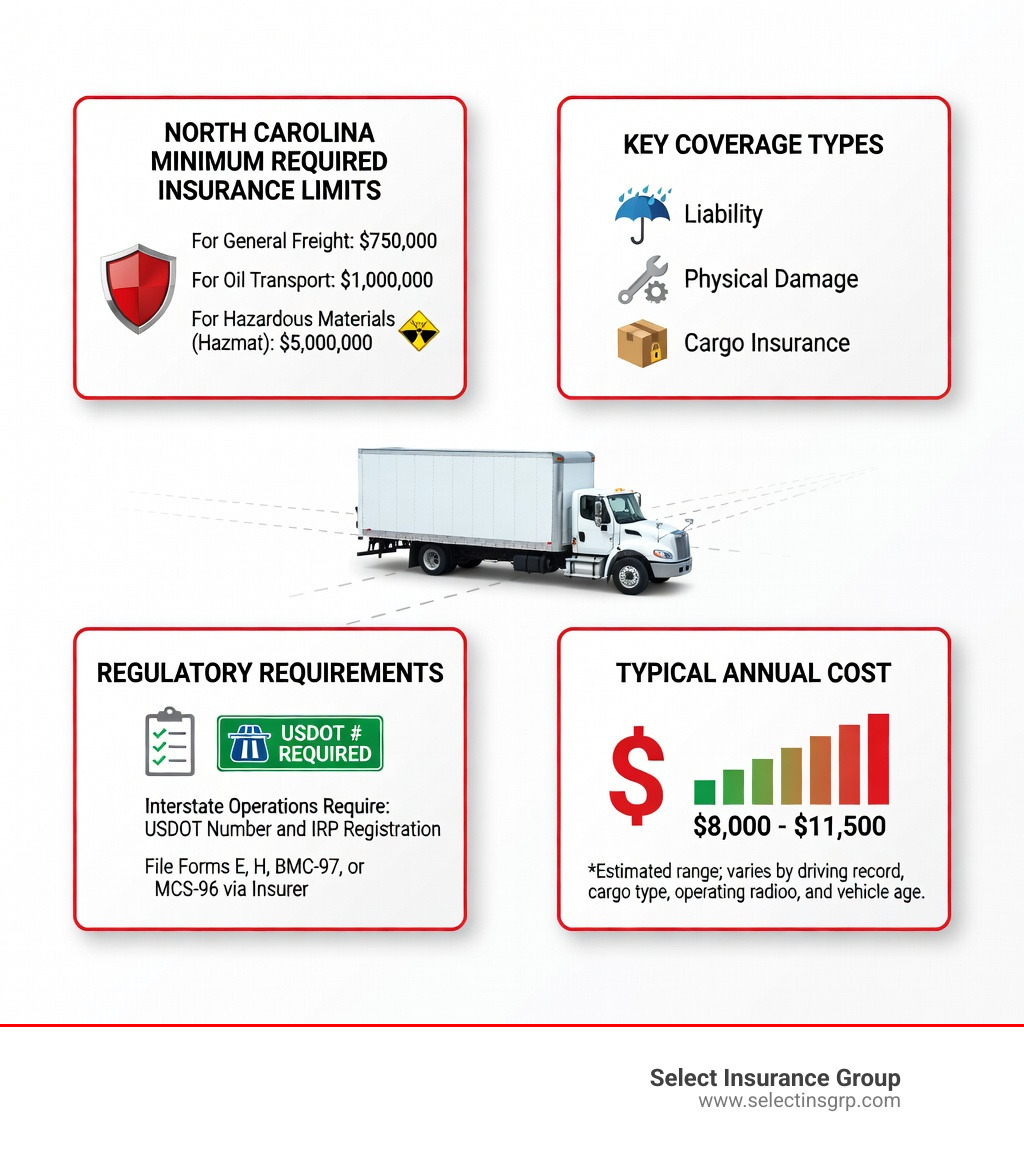
Commercial box truck insurance North Carolina is specialized coverage designed to protect medium-duty trucks with enclosed cargo areas against accidents, liability claims, property damage, and cargo loss. If you operate a box truck for business purposes in North Carolina, you need commercial insurance—not personal auto coverage—and North Carolina requires minimum liability limits of $750,000 for general freight (intrastate), $1,000,000 for oil transport, and $5,000,000 for hazardous materials. Essential coverage components include:
- Primary Liability Coverage – Protects against bodily injury and property damage claims
- Physical Damage Coverage – Covers collision and comprehensive losses to your truck
- Cargo Insurance – Protects goods in transit from damage, theft, or destruction
- Non-Trucking Liability – Covers personal use of your truck outside dispatch
- Medical Payments/PIP – Pays medical expenses for you and your passengers
North Carolina is home to 934,000 small businesses, many of which rely on box trucks for delivery services, furniture moving, retail distribution, and construction work. From the Research Triangle to Charlotte’s logistics hubs, box trucks keep North Carolina commerce moving—but without proper insurance, a single accident can devastate your business. Whether you’re hauling electronics from Raleigh or furniture from Greensboro, the right insurance protects both your vehicle and your livelihood.
The state requires commercial vehicles over 26,000 pounds or with three or more axles to register under the International Registration Plan (IRP) for interstate operations. Interstate carriers must also obtain a USDOT number and file specific regulatory forms (Form E, Form H, BMC-97, or MCS-96) through their insurance company. Annual premiums typically range from $8,000 to $11,500, depending on factors like your driving history, cargo type, operating radius, and vehicle age.
I’m D.J. Hearsey, founder and CEO of Select Insurance Group, and for over three decades I’ve specialized in helping North Carolina businesses navigate the complexities of commercial box truck insurance in North Carolina across our Southeastern locations. My team works with more than 20 carriers to find coverage that balances comprehensive protection with competitive rates for box truck operators throughout the Tar Heel State.
Quick commercial box truck insurance north carolina terms:
Understanding Commercial Box Truck Insurance in North Carolina
When we talk about box trucks—often called cube trucks, bobtails, or box vans—we are looking at the workhorses of the North Carolina economy. These are medium-duty trucks characterized by a separate, box-like cargo area sitting on the chassis. Because these vehicles are significantly heavier and larger than your average SUV, they carry a much higher risk profile.
In the Tar Heel State, securing the right insurance isn’t just a “good idea”—it’s a foundational requirement for your business’s financial survival. Unlike a personal auto policy, which usually excludes any vehicle used for commercial delivery or hauling, a commercial policy is built to handle the heavy lifting. It provides a safety net that covers the vehicle, the driver, and the assets of the business itself.
More info about North Carolina Commercial Insurance can help you understand how these policies integrate with your broader business strategy. Whether you are navigating the mountains near Asheville or the coastal roads of Wilmington, the goal of this insurance is to ensure that one bad day on I-40 doesn’t result in the end of your company.
Who Needs Commercial Box Truck Insurance in North Carolina?
With over 934,000 small businesses operating in our state, the demand for local hauling is immense. If you use a box truck to generate income, you fall into this category. We frequently see a variety of industries requiring this specialized coverage:
- Delivery and Courier Services: Bringing everything from Amazon packages to medical supplies to front doors.
- Furniture and Appliance Movers: A staple industry in North Carolina, especially given our history with furniture manufacturing.
- Retail and Wholesale Distribution: Moving goods from warehouses in Charlotte to storefronts in Raleigh.
- Construction and Contracting: Hauling heavy tools, lumber, or specialized equipment to job sites.
- Independent Contractors: Owner-operators who lease their services to larger logistics firms.

Even if you are a “one-man shop” with a single truck, the state views you as a commercial motor carrier. If that truck is involved in an accident, the potential for property damage and bodily injury is much higher than a standard car. That is why the state and federal governments mandate specific, higher limits for these vehicles.
Essential Coverage Components for NC Box Trucks
Navigating the “menu” of insurance options can feel overwhelming, but we like to break it down into the “must-haves” and the “should-haves.”
- Primary Liability: This is the big one. It is mandatory. If your driver is at fault in an accident, this pays for the other party’s medical bills and property damage. In North Carolina, the state minimum for basic auto is 30/60/25, but for box trucks, you are looking at much higher federal and state-mandated limits (often starting at $750,000).
- Physical Damage Coverage: This protects your investment. It consists of two parts:
- Collision: Covers damage to your truck if you hit another vehicle or object.
- Comprehensive: Covers “acts of God” or non-collision events like fire, theft, vandalism, or a tree falling on the truck during a Carolina hurricane.
- Medical Payments/PIP: This covers medical expenses for the driver and passengers in your truck, regardless of who is at fault.
- Uninsured/Underinsured Motorist: Unfortunately, not everyone on the road carries enough insurance. This protects you if your truck is hit by someone who lacks adequate coverage.
For a deeper dive into how these function within the state’s legal framework, you can review the Commercial Auto and Business Insurance Resources provided by the NC Department of Insurance.
The Importance of Cargo Insurance for Box Trucks
If the truck is the body of your business, the cargo is the lifeblood. Whether you’re hauling high-end electronics, vintage furniture, or crates of North Carolina sweet potatoes, that cargo has value. If it’s damaged in a wreck, stolen from the back of the truck, or ruined by a reefer unit failure, who pays for it?
Without specific cargo insurance, you do. Most primary liability policies do not cover the goods inside the box. Cargo insurance is often a requirement from your clients; most shippers won’t even let you load their goods until you show proof of cargo coverage, often at a $100,000 limit or higher.
More info about North Carolina Business Auto will show you that cargo insurance needs to be tailored. A truck hauling bread loaves needs a different limit than one hauling server racks for a data center in the Research Triangle.
Non-Trucking Liability vs. Bobtail Coverage
This is a common area of confusion for new owners. Let’s clear the air:
- Non-Trucking Liability (NTL): This covers you when you are using your truck for personal reasons. Imagine you’ve finished your route for the day, you’re off the clock, and you drive the truck to the grocery store or a movie. If you get in an accident, your primary commercial liability (which is for business use) might not cover you. NTL fills that gap.
- Bobtail Coverage: This is slightly different. It covers the truck when it is being operated without a trailer attached, regardless of whether you are on a job or not. While box trucks don’t usually “drop” a trailer like a semi would, “bobtail” is often used as a catch-all term in the industry for liability when not hauling a load.
North Carolina Regulatory Requirements and Liability Limits
Operating a box truck in North Carolina means answering to two “bosses”: the North Carolina Department of Transportation (NCDOT) and the Federal Motor Carrier Safety Administration (FMCSA).
- Intrastate vs. Interstate: If you only drive within North Carolina borders, you are an intrastate carrier. If you cross into South Carolina, Virginia, or beyond, you are an interstate carrier and must comply with federal FMCSA rules.
- USDOT Number: Most commercial vehicles over 10,000 lbs GVW operating in NC need a USDOT number. This is your “permanent record” for safety audits and inspections.
- IRP Registration: If your truck is over 26,000 lbs or has 3+ axles and you travel interstate, you must register under the International Registration Plan to ensure your registration fees are distributed correctly among the states you drive through.
For a complete checklist, we recommend looking at the Motor Carrier Insurance Requirements to ensure your authority is active and legal.
Minimum Liability Limits for NC Intrastate Carriers
North Carolina is strict about its limits to ensure that if a heavy truck causes damage, there is enough money to make the victims whole. The minimum liability limits for trucks over 10,000 lbs GVW are:
- $750,000: General Freight (the standard for most box trucks).
- $1,000,000: Oil Transport (moving petroleum products).
- $5,000,000: Hazardous Materials (explosives, toxic chemicals, etc.).
- $300,000: Household Goods Movers (specifically for those moving personal belongings).
Required Regulatory Filings To prove to the state that you have this insurance, your insurance company must submit specific filings:
- Form E: Certifies that your liability insurance meets the state’s requirements.
- Form H: Certifies that you have the required cargo insurance.
- BMC-97: Often required for brokers or specific federal authorities.
Factors Influencing the Cost of Box Truck Premiums
Why does one driver pay $8,000 while another pays $12,000? It’s not just luck. Insurance companies use a complex “recipe” to determine your risk.
| Factor | Impact on Premium | Why? |
|---|---|---|
| Driving History | High | Accidents or speeding tickets in the last 3-5 years suggest future risk. |
| Driver Experience | Medium | New CDL holders often pay more than veterans with 10+ years of clean driving. |
| Operating Radius | Medium | Local deliveries (under 100 miles) are generally cheaper than long-haul routes. |
| Cargo Type | High | Hauling hazardous materials or high-theft items (electronics) increases cost. |
| Vehicle Age | Medium | Newer trucks have better safety tech, but older trucks are cheaper to replace. |
| Safety Features | Low (Discount) | Dash cams, ELDs, and collision-avoidance systems can earn you discounts. |
Maintaining a clean Motor Vehicle Record (MVR) is the single best way to keep your commercial box truck insurance North Carolina costs down. Even a minor “fender bender” can cause your rates to spike for several years.
How to Obtain a Quote for Commercial Box Truck Insurance in North Carolina
Getting a quote shouldn’t feel like a trip to the dentist. To get the most accurate pricing, you should have your information ready before you call us.
- Vehicle Specs: Year, make, model, and VIN for every truck.
- Driver Info: Name, date of birth, and driver’s license number for everyone who will be behind the wheel.
- Usage Details: What are you hauling? Where are you going? How many miles do you drive a year?
- Current Policy: If you already have insurance, having your “dec page” (declarations page) helps us compare apples to apples.
At Select Insurance Group, we recommend a multi-quote comparison. Because we shop over 40 different carriers, we can find the one that is “hungry” for your specific type of business.
Ready to see what we can do for you? Get a Quote today and let our team do the heavy lifting.
Frequently Asked Questions about NC Box Truck Insurance
What is the average cost of commercial box truck insurance in North Carolina?
The typical annual range we see is $8,000 to $11,500 per truck. However, this is just an average. A “new venture” (a business that just started) might pay a bit more because they don’t have a proven safety track record. Conversely, an established fleet with a decade of clean inspections might see rates significantly lower.
Can I bundle multiple box trucks under a single fleet policy?
Absolutely. In fact, we recommend it. If you have two or more trucks, a fleet policy can simplify your life. You get one bill, one renewal date, and often a “fleet discount.” It also makes it much easier to add or remove drivers and vehicles as your business grows or changes.
Does North Carolina require a CDL for all box truck drivers?
Not necessarily. In North Carolina, you generally only need a Commercial Driver’s License (CDL) if the vehicle’s Gross Vehicle Weight Rating (GVWR) is 26,001 pounds or more. Many standard box trucks are rated at 25,999 lbs specifically so that drivers don’t need a CDL. However, even if a CDL isn’t required, you still need commercial insurance, and your insurance carrier will still vet your drivers’ records thoroughly.
Conclusion
Navigating commercial box truck insurance North Carolina doesn’t have to be a headache. Whether you are a small business owner in Charlotte or an independent contractor in Wilmington, having the right protection is what allows you to drive with confidence.
At Select Insurance Group, we bring over 30 years of experience to the table. We understand the North Carolina roads, the local regulations, and the unique challenges faced by truckers in the Southeast. By shopping over 40 carriers, we ensure that you aren’t “boxed in” by a policy that doesn’t fit your needs or your budget.
Don’t leave your livelihood to chance. Let us help you build a policy that protects your truck, your cargo, and your future. Visit our North Carolina Commercial Insurance page to learn more or give us a call to start your customized quote today. Keep the shiny side up and the rubber side down—we’ve got your back.