Why Home and Auto Insurance in North Carolina Protects Your Biggest Investments
Home and auto insurance North Carolina residents need includes minimum liability coverage of $30,000/$60,000/$25,000 for vehicles, plus optional but highly recommended homeowners protection for property damage, theft, and natural disasters. Most North Carolina lenders require home insurance if you have a mortgage, and driving without auto insurance can result in fines, license suspension, and vehicle impoundment.
Quick Answer for North Carolina Residents:
- Minimum Auto Insurance Required: $30,000 per person/$60,000 per accident for bodily injury, $25,000 for property damage
- Homeowners Insurance: Not required by law, but typically mandatory if you have a mortgage
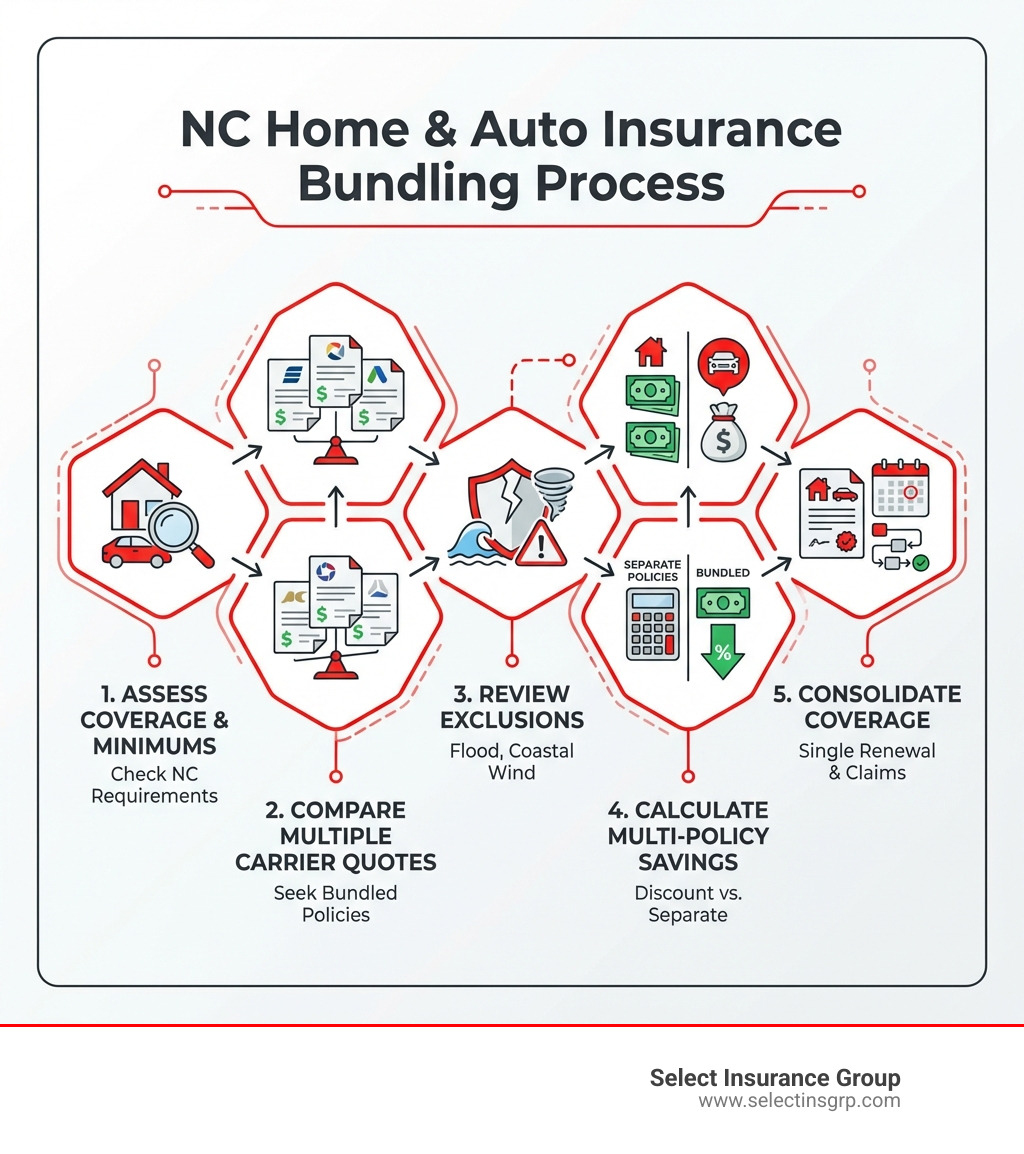
- Bundling Benefits: Save up to 20% by combining home and auto policies with one carrier
- Key Exclusions: Standard policies don’t cover floods, earthquakes, or certain coastal wind damage without separate coverage
- Consequences of No Coverage: Fines, license suspension, vehicle impoundment, and increased future premiums
North Carolina presents unique insurance challenges. The state faces hurricanes, tornadoes, winter storms, floods, and wildfires — making comprehensive coverage essential for homeowners. Meanwhile, drivers must steer specific requirements like uninsured motorist coverage and teen driving laws that impact family policies.
Bundling your home and auto insurance simplifies this complexity while reducing costs. Instead of managing two separate policies, two renewal dates, and two sets of paperwork, you get one streamlined experience. The average North Carolina household can save hundreds of dollars annually through multi-policy discounts.
But savings only matter if you have the right coverage. Too many residents find gaps in their policies after filing a claim. Standard homeowners insurance doesn’t cover flood damage — a critical exclusion for coastal and riverside properties. Similarly, minimum auto liability limits might not adequately protect your assets if you’re found at fault in a serious accident.
This guide walks you through North Carolina’s insurance requirements, explains how bundling works, and helps you identify coverage gaps before disaster strikes. You’ll learn which policies protect against the state’s most common perils, how factors like your driving record and home construction affect rates, and where to find licensed agents who know the local market.
I’m D.J. Hearsey, founder of Select Insurance Group, and I’ve spent over three decades helping Southeastern families secure comprehensive home and auto insurance North Carolina residents can rely on, working with 40+ carriers to find the right coverage at competitive rates. Whether you’re a first-time homebuyer in Charlotte, a coastal property owner in Wilmington, or a parent adding a teen driver in Raleigh, understanding your options starts here.
Similar topics to home and auto insurance north carolina:
Understanding Home and Auto Insurance North Carolina Requirements
When we talk about home and auto insurance North Carolina style, we have to start with the “must-haves.” North Carolina law is very clear about what you need to legally hit the road, but the rules for your home are a bit more flexible—at least legally speaking.
Auto Insurance: The Legal Minimums
In the Tar Heel State, you cannot even register a vehicle without proof of insurance. The state mandates specific liability limits, often written as 30/60/25. Here is what those numbers actually mean:
- $30,000 Bodily Injury Liability: The maximum amount your insurance will pay for one person’s injuries in an accident you cause.
- $60,000 Bodily Injury Liability: The total limit your insurance will pay for all injuries per accident.
- $25,000 Property Damage Liability: This covers damage you cause to someone else’s car, fence, or building.
Additionally, North Carolina requires Uninsured Motorist (UM) coverage. This protects you if you’re hit by someone who doesn’t have insurance. While Underinsured Motorist (UIM) coverage isn’t mandatory, we often recommend it because $30,000 doesn’t go very far in a modern hospital. You can learn more about these specifics on our North Carolina Auto Insurance page.
Homeowners Insurance: The Lender’s Mandate
Technically, North Carolina law does not require you to have homeowners insurance. You could own a home outright and “self-insure” (which is a fancy way of saying “cross your fingers”). However, if you have a mortgage, your lender will absolutely require it. They want to protect their investment just as much as you do.
Most lenders require you to carry at least enough coverage to pay off the mortgage balance, but we suggest insuring for the full replacement cost of the home. Market value (what you could sell it for) and replacement cost (what it costs to rebuild from scratch) are two very different numbers in today’s economy!
Navigating Auto Coverage and Teen Driving Laws
If you have a teenager in the house, you know that the transition from passenger to driver is both exciting and terrifying. North Carolina’s Graduated Driver Licensing (GDL) system is designed to keep young drivers safe, but it also has a significant impact on your home and auto insurance North Carolina rates.
The Stages of Teen Driving
North Carolina teens can start the process at age 15. The levels include:
- Level 1 Limited Learner Permit: Requires 12 months of supervised driving.
- Level 2 Limited Provisional License: Allows unsupervised driving during certain hours after 6 months of safe driving.
- Level 3 Full Provisional License: The final stage with fewer restrictions.
Learn more about North Carolina teen driving laws to ensure your young driver is compliant. Adding a teen to your policy is famously expensive, but bundling can help soften the blow.
Beyond the Minimums: Comprehensive and Collision
While the state only requires liability, if you are financing a car, your lender will require:
- Collision Coverage: To repair your car after an accident.
- Comprehensive Protection: To cover non-collision events like theft, fire, or — very common in NC — hitting a deer.
- Medical Benefits: This can help pay for medical or funeral expenses for you and your passengers, regardless of who is at fault.
Wondering how our state compares to others? Check out our article: Is Auto Insurance Less Expensive in North Carolina.
Protecting Your Property: Home Insurance Essentials
North Carolina’s geography is diverse, ranging from the Outer Banks to the Blue Ridge Mountains. This means your home insurance needs to be just as varied. A standard policy in Raleigh might look quite different from one in Wilmington.
Common Policy Types
Not all homeowners policies are created equal. Here are the most common forms we see in North Carolina:
| Policy Type | Best For | What it Covers |
|---|---|---|
| HO3 (Special Form) | Standard Homes | “Open Perils” for the structure; “Named Perils” for contents. This is the most popular choice. |
| HO4 (Renters) | Tenants | Personal property and liability only (not the building). |
| HO6 (Condo) | Condo Owners | “Walls-in” coverage and personal property. |
| HO8 (Modified) | Older Homes | Designed for homes where the replacement cost is much higher than the market value. |
For a deeper dive into these options, the North Carolina Home Insurance page is a great resource, or you can consult the official Consumer Guide to Homeowners Insurance.
The “Big Three” Exclusions: Flood, Wind, and Earthquakes
One of the most important things we tell our clients is what a standard policy doesn’t cover.
- Flood: Standard home and auto insurance North Carolina policies almost never cover flooding. You need a separate policy through the National Flood Insurance Program (NFIP) or a private carrier.
- Wind and Hail: In coastal counties, wind and hail might be excluded from your main policy. You may need to purchase this through the North Carolina Coastal Property Insurance Pool (often called the “Beach Plan”).
- Earthquakes and Mudslides: While rare, these are also typically excluded and require a specific endorsement.
Maximizing Savings with Insurance Bundles
Now, let’s get to the good stuff: the savings. Bundling is the insurance industry’s version of a “Value Meal.” When you buy your home and auto policies from the same company, everyone wins.
Why Bundle Home and Auto Insurance North Carolina?
- The Multi-Policy Discount: This is the big one. Most carriers offer a discount of 10% to 20% off your total premiums.
- Single Deductible: Some carriers offer a “vanishing” or single deductible. If a massive storm damages both your roof and the car in your driveway, you might only have to pay one deductible instead of two.
- Streamlined Claims: If a disaster hits, you only have one company to call. This reduces the “he-said, she-said” between different insurance companies.
- Loyalty Rewards: Bundled customers are less likely to be dropped after a single claim because the carrier values the total relationship.
Ready to see how much you can save? Get a Quote from our team today.
Factors Influencing Home and Auto Insurance North Carolina Rates
It isn’t just about bundling; several other factors play into your final price:
- Driving Record: Speeding tickets and at-fault accidents are the quickest way to see your rates climb.
- Credit Score: In North Carolina, insurance companies can use your credit-based insurance score to help determine your premium.
- Location: Living in a high-crime area or a flood zone will increase costs. Conversely, living near a fire station can lower them.
- Construction Type: Brick homes often cost less to insure than frame homes because they are more fire-resistant.
To find out where the deals are, read our guide on Where in North Carolina is Auto Insurance the Least Expensive.
Frequently Asked Questions about NC Insurance
What are the consequences of driving without insurance in North Carolina?
Driving without insurance in NC is a serious mistake. If you’re caught, you face:
- Civil Penalties: Fines ranging from $50 to $150.
- License Suspension: Your plates and license could be suspended for 30 days or more.
- Criminal Charges: It is a Class 3 misdemeanor.
- Financial Ruin: If you cause an accident, you are personally responsible for all medical bills and property damage. This can lead to garnished wages and lost assets.
Does standard NC homeowners insurance cover flood damage?
No. This is a common and dangerous misconception. Whether it’s a hurricane surge or a heavy inland rainstorm, water that comes from the “ground up” is considered a flood and is excluded from standard policies. Because North Carolina is at high risk for natural disasters, we strongly recommend checking the NFIP maps for your area.
How do I find a licensed insurance agent in North Carolina?
You can verify the license of any agent or company through the North Carolina Department of Insurance (NCDOI) website. However, the best way to shop is through an independent agency. Unlike “captive” agents who only sell one brand, independent agents like us shop dozens of carriers to find the best fit for your specific needs. If you’re looking for an Insurance Agency Charlotte residents trust, or help anywhere else in the state, we are here to help.
Conclusion
Navigating home and auto insurance North Carolina requirements doesn’t have to be a headache. By understanding the state’s minimums, recognizing the unique risks posed by our local weather, and leveraging the power of bundling, you can protect your family and your finances simultaneously.
At Select Insurance Group, we bring over 30 years of experience to the table. We don’t just work for one insurance company; we work for you. We shop over 40 different carriers to ensure you’re getting the most competitive rates without sacrificing the quality of your coverage.
Whether you need a standard bundle or specialized North Carolina Business Auto coverage, our team is ready to provide the personalized service you deserve. Don’t wait for the next hurricane season or a surprise fender-bender to find out if you’re covered.
Reach out to us today for a comprehensive review of your policies. Let’s make sure your North Carolina home and vehicles are protected with a bundle that makes sense for your budget.