Why North Carolina Businesses Need Commercial Auto Insurance
Commercial auto insurance north carolina is a specialized policy that protects businesses from financial losses when company-owned or employee-used vehicles are involved in accidents. If your North Carolina business uses vehicles for work, this coverage is essential.
Quick Answer: Do You Need Commercial Auto Insurance in NC?
- Required for: Any vehicle owned by your business and used for work.
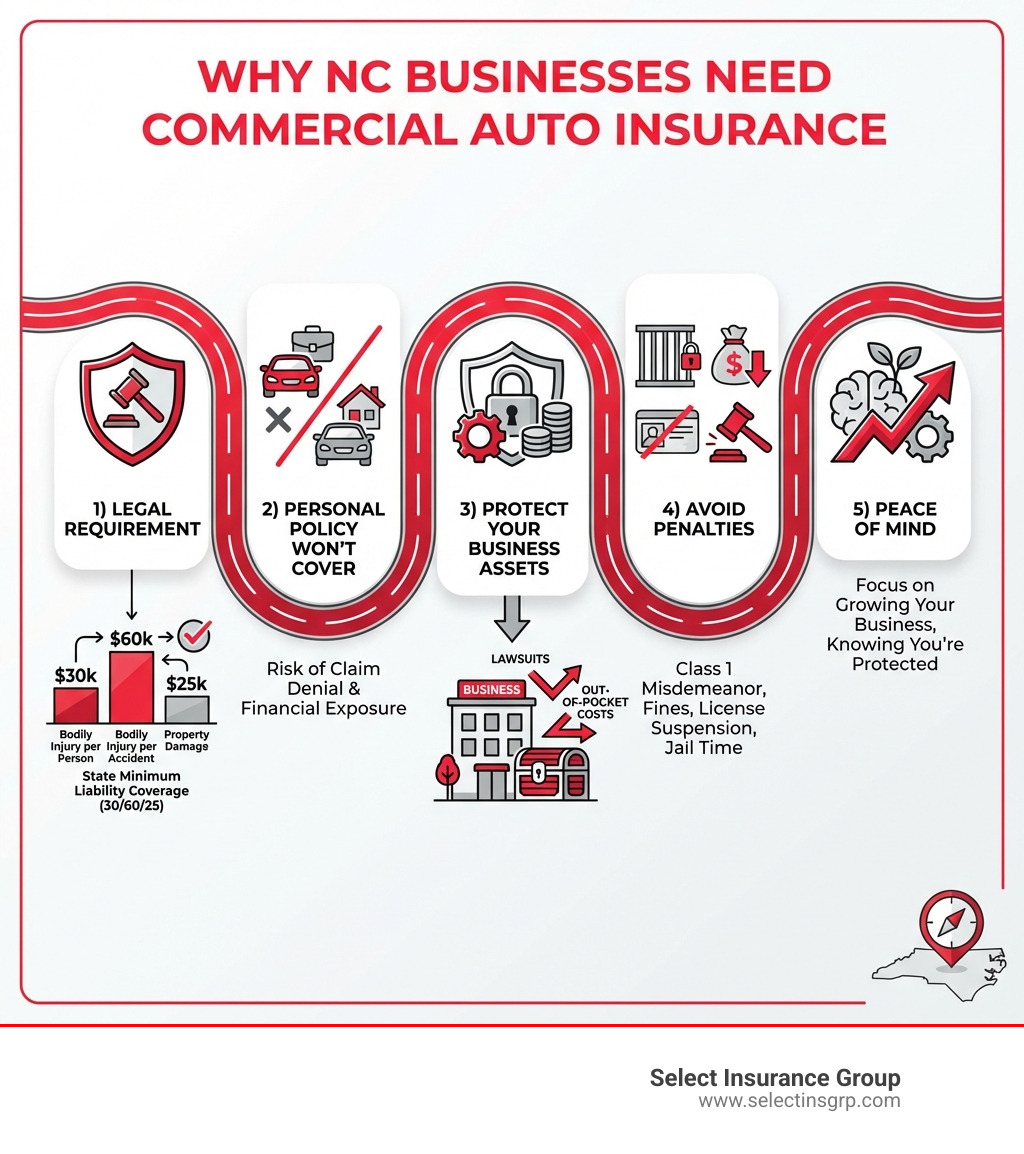
- State Minimums: $30,000 per person / $60,000 per accident for bodily injury, $25,000 for property damage.
- Also Covers: Employees using personal vehicles for business tasks (with Hired and Non-Owned Auto coverage).
- Average Cost: Approximately $148 per month.
- Penalties Without It: Class 1 misdemeanor, fines, license suspension, and potential jail time.
Many of North Carolina’s 934,000 small businesses rely on vehicles daily. Whether delivering products in Charlotte or hauling equipment in Greensboro, personal auto insurance won’t cover work-related activities. This coverage gap can leave you financially exposed.
North Carolina law requires all vehicles to have liability insurance, but business use demands higher limits. Without proper commercial coverage, you risk legal penalties and the devastating cost of paying for an accident out-of-pocket. A single serious accident can lead to lawsuits and medical bills that could end your business.
I’m D.J. Hearsey, founder and CEO of Select Insurance Group. For over 30 years, I’ve helped businesses secure commercial auto insurance north carolina that protects their operations. This guide will walk you through everything you need to know to make the right decision for your business.
Handy commercial auto insurance north carolina terms:
Understanding the Essentials of Commercial Auto Insurance
Commercial auto insurance north carolina is a critical safety net for the unique risks your business vehicles face. It’s a policy that covers costs if a business-owned vehicle is in an accident, including property damage and medical expenses. It is legally required for any vehicles used for work purposes in North Carolina. Let’s explore what it is, who needs it, and how it differs from personal car insurance.
Who Needs Commercial Auto Insurance in North Carolina?
Any North Carolina company that uses vehicles for business purposes needs this coverage. This includes a wide range of businesses, not just large fleets. Many of North Carolina’s 934,000 small businesses fall into this category.
You typically need commercial auto insurance north carolina if your business:
- Owns vehicles registered in the company name (cars, trucks, vans).
- Transports goods, products, or equipment (delivery services, contractors, caterers).
- Transports people for a fee (taxis, shuttles, NEMT services).
- Has employees who use their personal cars for work-related tasks like client visits or running errands.
- Operates specialized vehicles like food trucks, dump trucks, or tractor-trailers.
- Uses a vehicle with business signage or advertising.
In short, if a vehicle is integral to your business operations, it needs commercial auto insurance.
The Critical Difference: Personal vs. Commercial Policies
A common question is whether personal car insurance can cover a business vehicle. The answer is almost always “no.” The differences are vast, and misunderstanding them can lead to severe financial and legal consequences.
Here are the key differences:
| Feature | Personal Auto Insurance | Commercial Auto Insurance |
|---|---|---|
| Primary Use | Personal, recreational, commuting to and from work | Business-related activities, transporting goods/people, client visits |
| Liability Limits | Generally lower, designed for individual risk | Significantly higher, reflecting greater financial exposure of a business |
| Coverage Scope | Covers individual, family members, and personal vehicles | Covers business entity, employees, and vehicles used for business |
| Vehicle Types | Private cars, SUVs, sometimes light trucks | Wide range: cars, vans, pickup trucks, box trucks, tractor-trailers, specialized vehicles |
| Business Use | Typically excluded or severely limited | Explicitly covered, including specific business operations |
| Additional Coverages | Limited to personal needs (e.g., rental car reimbursement) | Specialized coverages (e.g., cargo, HNOA, towing, loading/unloading) |
Coverage Gaps: Personal auto policies have specific exclusions for business activities. If an accident occurs while you’re making a delivery or visiting a client, your personal insurer will likely deny the claim, leaving your business responsible for all costs.
Higher Liability Limits: Businesses face greater liability risks. An accident with a commercial vehicle can cause extensive damage and injuries, quickly exceeding the limits of a personal policy. Commercial auto insurance north carolina offers much higher liability protection to safeguard your business assets.
Using a Personal Vehicle for Work: If you or your employees use personal vehicles for business, the personal policy won’t cover an accident. This is where Hired and Non-Owned Auto (HNOA) insurance becomes essential to bridge this critical coverage gap.
Without proper commercial auto insurance north carolina, your business’s financial health and existence could be jeopardized by a single incident.
For more detailed information on insuring your business vehicles, visit our page on North Carolina Business Auto.
Your Guide to Commercial Auto Insurance North Carolina Requirements
Navigating the legal landscape of commercial auto insurance north carolina is a non-negotiable part of running a compliant business. North Carolina has specific minimums, and federal regulations apply to certain motor carriers. Failing to meet these requirements can lead to severe penalties.
North Carolina’s Minimum Liability Requirements
All vehicles in North Carolina, including commercial ones, must carry minimum liability insurance. This is often called the 30/60/25 rule:
- $30,000 bodily injury liability per person: Covers injuries to one person in an at-fault accident.
- $60,000 bodily injury liability per accident: The total amount paid for all injuries in a single at-fault accident.
- $25,000 property damage liability per accident: Covers damage to other people’s property in an at-fault accident.
North Carolina also requires Uninsured Motorist (UM) coverage, which protects you if you’re in an accident with an uninsured driver or a hit-and-run. While Underinsured Motorist (UIM) coverage is optional, it’s highly recommended to cover costs if an at-fault driver has insufficient insurance.
It is crucial for businesses to consider much higher limits than the state minimums. A serious accident can easily exceed these amounts, so limits of $500,000 or $1,000,000 are common to protect business assets.
For a comprehensive understanding, we recommend reviewing A Consumer’s Guide to Auto Insurance (NC Department of Insurance).
Penalties for Driving Uninsured in NC
Driving without the required commercial auto insurance north carolina is illegal and carries significant penalties:
- Fines: Starting at $50 for a first offense.
- Suspension: Your vehicle’s registration and license plates can be suspended.
- Criminal Charge: A Class 1 misdemeanor charge can lead to probation or up to 45 days in jail.
- Higher Premiums: Your future insurance costs will likely increase.
- Out-of-Pocket Costs: If an uninsured business vehicle causes an accident, your business is responsible for all damages, which can be financially devastating.
Federal Requirements for Motor Carriers
For businesses that transport goods or passengers for compensation (motor carriers), federal regulations may impose additional insurance requirements, especially for interstate commerce.
Key federal requirements include:
- USDOT Number: Required for commercial vehicles that meet certain criteria (e.g., weight over 10,001 pounds, transporting hazardous materials). This number is issued by the Federal Motor Carrier Safety Administration (FMCSA) and tracks your company’s safety record.
- Higher Liability Limits: FMCSA minimum liability limits are significantly higher than North Carolina’s, often ranging from $750,000 to several million dollars, depending on the cargo and operation.
- Intrastate Commerce: North Carolina often adopts federal standards for heavier vehicles operating within the state.
If your business is a motor carrier, meeting these federal mandates is crucial to avoid hefty fines and out-of-service orders. We can help you steer these complex requirements.
For more detailed information on federal requirements, refer to the Motor Carrier Insurance Requirements (DOT Operating Authority).
Customizing Your Coverage: Options and Cost Factors
Just as every North Carolina business is unique, so too are its commercial auto insurance north carolina needs. A standard policy might cover the basics, but adding optional coverages and understanding what drives your costs can ensure your business has truly comprehensive protection. Let’s explore how to customize your policy and what factors influence your premiums.
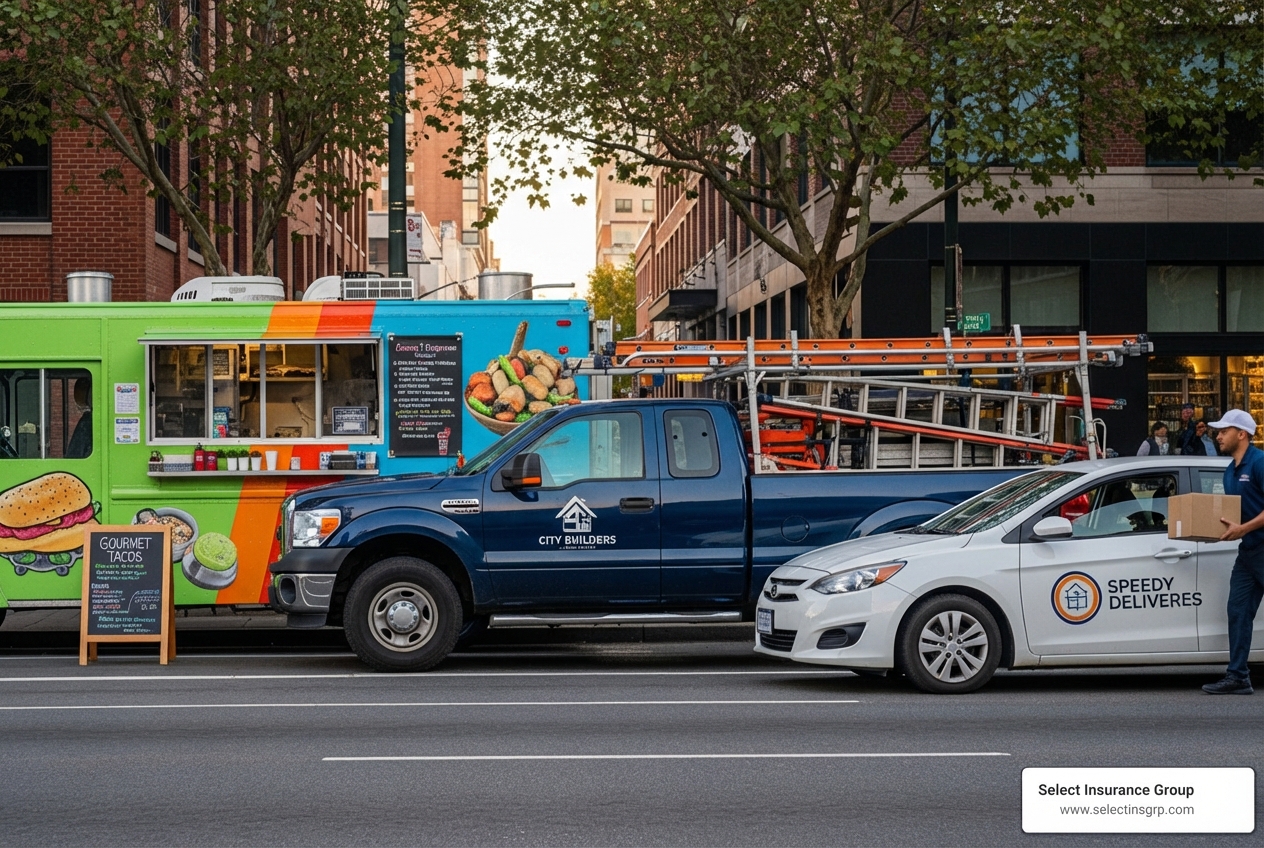
Common Commercial Auto Coverage Options
Beyond mandatory liability, consider these options to safeguard your business:
- Liability Coverage: The foundation of your policy. Covers injuries and property damage your business vehicle causes to others. Higher limits are strongly recommended for businesses.
- Collision Coverage: Pays to repair or replace your business vehicle after a collision, regardless of fault.
- Comprehensive Coverage: Covers damage to your vehicle from non-collision events like theft, vandalism, fire, or natural disasters.
- Medical Payments (MedPay) Coverage: Helps pay medical expenses for you, your employees, and passengers, regardless of who is at fault.
- Hired and Non-Owned Auto (HNOA) Insurance: A crucial add-on. Provides liability coverage for vehicles your business rents or borrows, and for employees’ personal vehicles used for work.
- Underinsured Motorist (UIM) Coverage: Protects you when an at-fault driver has insurance, but not enough to cover all your damages.
- Towing and Labor Coverage: Helps cover towing costs and on-site labor like changing a flat tire.
- Loading and Unloading Coverage: Protects against property damage that occurs while loading or unloading goods.
- Bobtail Coverage: For truckers, this protects the tractor when it’s driven without a trailer.
Choosing the right combination of these coverages is about assessing your business’s unique risks. We can help you tailor a policy that fits your specific needs. For more information on protecting your business from various risks, check out our page on North Carolina General Liability.
How is the cost of commercial auto insurance determined in North Carolina?
While the national average is around $148 per month, your premium depends on several factors:
- Vehicle Type and Weight: Heavier, more expensive, or specialized vehicles cost more to insure.
- Driving Records: Clean driving records for all drivers lead to lower premiums.
- Business Industry: Higher-risk industries, like construction, generally have higher rates.
- Travel Radius: Local routes are often cheaper to insure than long-haul or interstate travel.
- Claims History: A history of frequent or costly claims will increase your rates.
- Coverage Limits and Deductibles: Higher limits increase premiums but offer better protection. A higher deductible can lower your premium.
By carefully evaluating these factors, we can help you understand your quote and find ways to optimize your coverage and cost.
Insurance Needs for Different North Carolina Professions
Different businesses have unique insurance needs:
- Contractors and Construction: Need coverage for work trucks and vans, plus protection for tools and equipment. Higher liability limits are a must due to job site risks.
- Food Trucks and Catering: Require coverage for the specialized vehicle and its expensive attached equipment.
- Delivery and Courier Services: High mileage and frequent stops increase risk. Robust liability, collision, and comprehensive are needed. HNOA is essential if employees use their own cars.
- Landscaping Businesses: Need coverage for trucks and any attached trailers. Consider separate coverage for expensive equipment being transported.
- Real Estate Agents: Often use personal vehicles for business, including transporting clients. A personal policy likely won’t cover this, making HNOA or a commercial policy critical.
Understanding these industry-specific nuances allows us to craft a commercial auto insurance north carolina policy that truly protects your business’s unique operations.
Frequently Asked Questions about Commercial Auto Insurance in North Carolina
We understand that commercial auto insurance north carolina can be complex. Here are answers to some common questions.
What is the role of Personal Injury Protection (PIP) in North Carolina?
North Carolina is an “at-fault” state, meaning the at-fault driver’s insurance is responsible for damages.
For this reason, Personal Injury Protection (PIP), also known as “No-Fault Insurance,” is not required or available for personal auto insurance in North Carolina. Instead, personal policies may offer optional Medical Payments (MedPay) coverage, which pays for medical expenses regardless of fault.
For commercial auto insurance north carolina, the situation can vary. While NC is an at-fault state, some commercial insurance carriers may include or require a form of medical expense coverage similar to PIP as part of their policy structure.
The best approach is to consult with an experienced insurance agent. We can clarify the specific medical coverage options available in your commercial policy to ensure your drivers and passengers are adequately protected.
Are my tools and equipment covered by commercial auto insurance?
The short answer is no. Standard commercial auto insurance north carolina does not cover the contents within your vehicle, such as tools, equipment, or inventory. It covers liability for accidents and damage to the vehicle itself (with collision/comprehensive).
To protect these valuable assets, you need separate coverage:
- Inland Marine Insurance: Often called “tools and equipment coverage,” this protects your property while it’s in transit or at a job site.
- Cargo Coverage: For businesses that transport goods for others, this protects the cargo itself from damage or theft.
We can help you assess the value of your equipment and find the right policy to ensure it’s fully protected.
What if I only use my personal car for business part-time?
Even occasional business use of a personal car can create a major insurance gap.
- Personal Policy Exclusions: Most personal auto policies exclude business-related activities. If you have an accident while running a work errand, your insurer can deny the claim, leaving you personally liable for all costs.
- The Solution: Hired and Non-Owned Auto (HNOA) coverage is designed for this situation. It adds a layer of liability protection for your business when you or an employee uses a personal vehicle for work.
It is vital to be transparent with your insurance agent about how you use your vehicle. We can determine if you need to add HNOA to your business policy to avoid a potentially catastrophic uninsured loss. Don’t leave your business vulnerable.
Get the Right Protection for Your North Carolina Business
We’ve covered the essentials of commercial auto insurance north carolina, from legal requirements to coverage options. The message is clear: if your business uses vehicles, proper commercial auto insurance is a legal necessity and a cornerstone of your financial security.
Navigating insurance can be challenging, but you don’t have to do it alone. At Select Insurance Group, we use over 30 years of experience and access to more than 40 carriers to find you competitive rates and superior service. Our goal is to ensure your business is compliant and protected, so you can focus on growth.
Don’t let a coverage gap expose your hard-earned assets. Whether you’re a new startup or an established enterprise, we’re here to tailor a commercial auto insurance north carolina policy that fits your unique needs and budget.
Take the proactive step today to secure your business’s future on the road.