

Why Florida Workers Compensation Quotes Matter for Your Business
Florida workers compensation quotes are the first step to protecting your business from the high costs of workplace injuries while complying with state law. Understanding what you’ll pay for coverage—and how to get the best rate—can save you thousands annually.
Quick Answer: How to Get Florida Workers Compensation Quotes
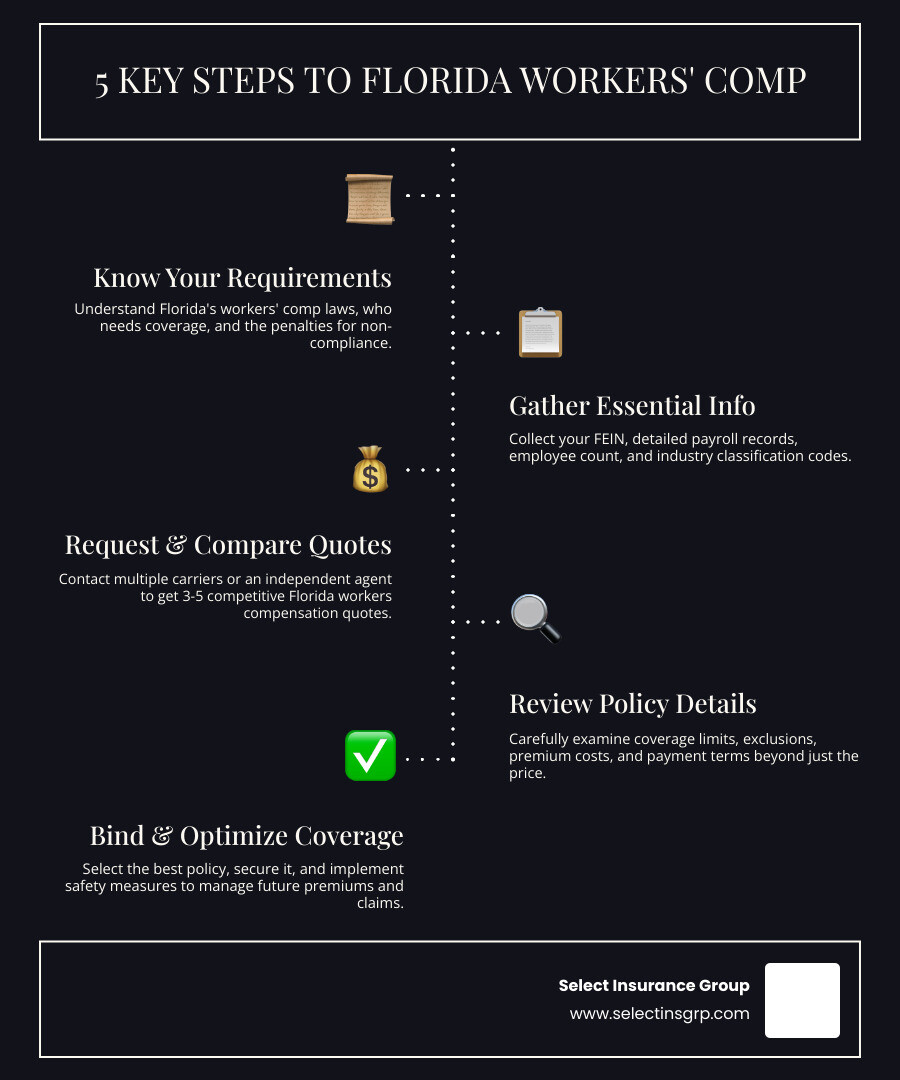
- Gather your business information: FEIN, payroll records, number of employees, and industry classification.
- Contact multiple insurance providers or an independent agent: Compare at least 3-5 quotes.
- Review coverage details and premiums: Look beyond price to check policy limits and exclusions.
- Secure your policy: Choose the best balance of cost and coverage, then bind your policy.
Most Florida businesses with four or more employees must carry workers’ comp insurance. Construction companies need it for every employee. Failure to comply can lead to stop-work orders (issued about 2,500 times per year in Florida) and penalties of double your estimated premiums for two years.
Your policy cost depends on your industry, payroll size, claims history, and number of employees. High-risk industries like construction pay more per $100 of payroll than lower-risk businesses like retail.
Without proper coverage, a single workplace injury could lead to lawsuits, fines, and temporary business closure. Workers’ comp protects your employees and your bottom line by covering medical bills, lost wages, and legal costs.
As D.J. Hearsey, founder and CEO of Select Insurance Group, I’ve spent over 30 years helping business owners secure competitive Florida workers compensation quotes. Our team works with more than 20 carriers to find you the right coverage at the right price.
Florida workers compensation quotes definitions:
Understanding Florida’s Workers’ Compensation Requirements
Understanding Florida’s workers’ compensation rules is crucial for every business owner. It’s not just about compliance; it’s about safeguarding your team and your livelihood.

Who Needs Workers’ Comp in Florida?
Florida’s requirements depend on your industry and number of employees.
Generally, workers’ compensation insurance is required for most businesses with four or more employees, including full-time, part-time, and seasonal workers.
Florida has stricter rules for certain industries:
- Construction Industry: Every business in construction must have workers’ comp coverage for each employee, including contractors and self-employed individuals. Even with just one employee, you need coverage.
- Agricultural Businesses: You must provide workers’ comp if you have six or more regular employees or 12 or more seasonal employees who work for more than 30 days per year.
A workers’ comp policy is optional for businesses with three or fewer employees (outside of construction). While not legally required, it’s a smart move to protect against unexpected workplace injuries. For more details, see our guide on More info about Florida Workers Compensation.
What is Workers’ Compensation Insurance?
Workers’ compensation is a no-fault system that provides a safety net for employees and employers. If an employee is injured on the job, they receive benefits regardless of who was at fault.
A policy covers medical expenses, lost wages, rehabilitation, and death benefits for work-related incidents. For employees, it provides financial support and medical care. For employers, it offers vital protection from costly lawsuits, as employees typically waive their right to sue in exchange for benefits.
When you request Florida workers compensation quotes, you’re getting an estimate for this comprehensive protection—an investment in your team’s well-being and your business’s stability.
Penalties for Non-Compliance
Ignoring Florida’s workers’ comp requirements carries severe consequences. The Division of Workers’ Compensation actively enforces the law.
The most immediate penalty is a stop-work order, which forces your business to cease all operations until you comply. These are common, with about 2,500 issued annually in Florida.
Beyond business disruption, financial penalties are steep. You could face a penalty of double your estimated workers’ comp insurance costs for two years. Non-compliance can also lead to temporary business closure, steep fines, and personal liability for owners if an uncovered employee is injured.
The risks of non-compliance far outweigh any perceived savings. For more details, you can review the state’s Details on stop-work orders-faqs.pdf?sfvrsn=7ecc094a_2). Compliance is about building a responsible and sustainable business.
What Does a Florida Workers’ Comp Policy Cover?
A Florida workers’ comp policy provides a comprehensive shield for your employees, covering everything from immediate medical needs to long-term financial support.

Medical and Rehabilitation Benefits
Workers’ comp covers all reasonable and necessary medical care for a work-related injury or illness, including:
- Emergency treatment: Ambulance rides and ER visits.
- Doctor visits: Appointments with specialists and other physicians.
- Hospital care: Coverage for hospitalization costs.
- Prescription drugs: Medications needed for recovery.
- Physical therapy: To regain strength and mobility.
- Vocational rehabilitation: Helps employees acquire new skills if they cannot return to their previous job.
This coverage removes a significant financial burden from both the injured employee and your business.
Lost Wage and Disability Benefits
If an employee cannot work due to their injury, the policy replaces a portion of their lost wages. Florida’s system includes several disability benefit types:
- Temporary Total Disability (TTD): Paid when an employee is temporarily unable to work, typically 66.67% of their average weekly wage.
- Temporary Partial Disability (TPD): If an employee returns to light duty at lower pay, TPD benefits make up a portion of the wage difference.
- Permanent Impairment Benefits (PIB): Paid once an employee reaches maximum medical improvement (MMI) with a permanent impairment. Employees may receive up to 75% of their temporary disability rate.
- Permanent Total Disability (PTD): Provides long-term support if an employee is permanently unable to return to any gainful employment, with benefits potentially lasting until age 75.
The Florida Department of Financial Services offers Benefit calculators to estimate payments. This system provides a safety net for employees and a structured way for employers to manage costs.
Death Benefits
In the tragic event of a work-related fatality, Florida workers’ comp death benefits provide financial support to the deceased’s dependents.
Benefits include up to $7,500 in funeral expenses and income benefits up to 66.67% of the deceased’s weekly wage, capped at a total of $150,000. This provides a vital safety net for families. The legal framework is defined in the Florida workers’ comp death benefits statute.
How to Get the Best Florida Workers Compensation Quotes
Securing competitive Florida workers compensation quotes means finding the right coverage at the best price. This requires understanding what influences your premium and how to steer the quoting process.
Key Factors That Influence Your Quote
Insurance carriers use several key factors to assess your risk and determine your premium. Understanding these can help you anticipate and manage costs.
- Industry Classification Codes: The National Council on Compensation Insurance (NCCI) assigns a code to each job type based on its risk. A high-risk job like roofing has a higher base rate than a low-risk office job.
- Total Payroll: Premiums are calculated as a rate per $100 of your total annual payroll. Higher payroll generally means a higher premium.
- Number of Employees and Work Type: More employees, especially in high-risk roles, will increase your premium.
- Claims History: A history of frequent or severe claims signals higher risk and leads to higher rates. A clean record can earn you discounts.
- Experience Modification Rate (EMR): This number compares your claims history to others in your industry. An EMR below the average of 1.0 results in a discount, while an EMR above 1.0 results in a surcharge.
- Business Location: Geographic location can also have a minor influence on rates.
Steps to Compare Florida Workers Compensation Quotes
A structured approach to comparing Florida workers compensation quotes will save you time and money.
- Gather Your Business Information: Have key data ready for an accurate quote, including: payroll records, FEIN, business details (name, address, structure), a description of operations, and your claims history (loss runs) for the last 3-5 years.
- Work with an Independent Insurance Agent: An independent agent can shop your information to numerous carriers, saving you time and presenting you with the best options for your specific needs.
- Compare Coverage Limits and Policy Details: Look beyond the premium. Review coverage limits, deductibles, and exclusions to ensure you’re not left vulnerable. Better coverage may be worth a slightly higher price.
- Review Policy Details Thoroughly: Understand payment terms, cancellation policies, and any insurer safety requirements before making a decision.
How Your Premium is Calculated
Your premium is determined by a specific formula, not a flat fee.
Premium = (Payroll / $100) x Base Rate x EMR x Discounts/Surcharges
- Base Rate: The starting rate for each job class per $100 of payroll, set by the NCCI code.
- Payroll per $100: Your total payroll divided into $100 units.
- Experience Modification Rate (EMR): A multiplier based on your claims history. A good safety record (EMR < 1.0) lowers your premium, while a poor one (EMR > 1.0) increases it.
- Credits and Debits: Insurers may apply additional adjustments for factors like safety programs or drug-free workplace policies.
This calculation creates a premium that reflects your business’s unique risk profile, which is why Florida workers compensation quotes vary so much between businesses.
Navigating Exemptions, Claims, and Other Insurance
Florida’s workers’ compensation system has important nuances, including exemptions, claims procedures, and how it differs from other business policies.
Are There Exemptions to Florida’s Rules?
While most businesses need coverage, some individuals can be exempt.
- LLC Members and Corporate Officers: In Florida, some business owners, officers, and LLC members can file for an exemption, meaning they opt out of the company’s workers’ comp policy.
- Industry Rules: Exemptions are easier to get for non-construction businesses. Construction has very strict “everyone covered” rules.
- Application Process: Exemptions are not automatic. You must File an exemption application with the Florida Division of Workers’ Compensation.
- Out-of-Pocket Risks: If an exempt owner or officer is injured at work, they are responsible for their own medical bills and lost wages. This is a significant financial risk that should be carefully considered.
The Claims Process and Statute of Limitations
Knowing the claims process and deadlines is vital for both employers and employees.
- Report the Injury: Employees should report work-related injuries to their employer, ideally within thirty days of the accident.
- Employer Action: The employer then has seven days to report the injury to their insurance company.
- Claim Processing: The insurer investigates the claim and, if approved, begins providing benefits.
- Two-Year Time Limit: The Florida statute of limitations for filing a workers’ comp claim is two years from the date of injury. If a claim isn’t filed in time, the worker may lose their right to benefits.
Workers’ Comp vs. Other Business Policies
It’s crucial to distinguish between workers’ comp and general liability insurance.
| Feature | Workers’ Compensation Insurance | General Liability Insurance |
|---|---|---|
| Primary Purpose | Covers employees for work-related injuries/illnesses. | Covers third parties for bodily injury or property damage. |
| Who is Covered | Your employees (medical bills, lost wages, rehabilitation). | Customers, vendors, the public (injuries or property damage). |
| Type of Incident | Accidents, illnesses directly linked to employment. | Slip-and-falls by customers, property damage caused by your business, advertising injury. |
| Legal Mandate | Mandated by state law for most employers in Florida. | Not always legally mandated, but highly recommended for all businesses. |
| Lawsuit Protection | Protects employer from employee lawsuits for work injuries. | Protects business from third-party lawsuits. |
| Example Scenario | An employee breaks their arm falling off a ladder at a job site. | A customer slips on a wet floor in your store and gets injured. |
In short, workers’ comp covers your employees, while general liability covers third parties. While workers’ comp is often required, Florida General Liability insurance is also vital for comprehensive business protection.
Frequently Asked Questions about Florida Workers’ Comp
Here are answers to common questions about Florida workers’ compensation.
What is the difference between workers’ compensation and business health insurance?
While both involve health, their purposes are distinct:
- Workers’ Compensation: Covers work-related injuries and illnesses only. It is state-mandated for most employers, who pay the full premium.
- Business Health Insurance: Provides 24/7 coverage for general medical needs, regardless of whether they are work-related. It is an optional benefit, and premiums are often shared between the employer and employee.
In short, workers’ comp is for on-the-job safety, while health insurance covers general well-being.
Do I need workers’ comp for 1099 subcontractors in Florida?
The answer depends on the industry and relationship.
- Construction Industry: The rules are strict. Every business doing construction work must have workers’ comp for each employee, including contractors. You must ensure your 1099 subcontractors have their own coverage, or you could be liable.
- Other Industries: The state uses a “true independent contractor” test, looking at factors like control over work and payment method. If a 1099 worker is deemed an employee, you are liable for their work-related injuries.
- Protecting Your Business: Always require 1099 subcontractors to provide a Certificate of Insurance as proof of their own workers’ comp coverage to avoid financial exposure.
How can I lower my Florida workers compensation quotes over time?
You can proactively lower your Florida workers compensation quotes by demonstrating a commitment to safety.
- Implement Safety Programs: A strong safety culture with regular training reduces injuries, improving your claims history and lowering your EMR.
- Establish Return-to-Work Programs: Helping injured employees return to light-duty work can reduce the cost of lost wage benefits.
- Maintain Accurate Records: Correctly classifying jobs and tracking payroll prevents overpayment.
- Manage Claims Efficiently: Promptly report and manage claims to control costs.
- Improve Your EMR: All these strategies help lower your Experience Modification Rate, which leads to premium discounts.
Focusing on safety and claims management leads to more favorable quotes in the long run.
Secure Your Business with the Right Coverage
Navigating Florida workers compensation quotes and requirements is essential for every business owner. This coverage is mandatory for most, and it protects both your employees and your business.
Remember the key takeaways:
- Compliance is Mandatory: Most businesses with four or more employees (and all in construction) must have workers’ comp to avoid stop-work orders and heavy fines.
- It Protects Everyone: It provides employees with medical and wage benefits for work injuries and shields your business from lawsuits.
- Cost is Based on Risk: Your industry, payroll, and claims history (EMR) determine your premium.
- Shop Smart: Comparing quotes with an independent agent is the best way to find competitive pricing.
At Select Insurance Group, our 30+ years of experience help us find the right policy for your Florida business. We compare Florida workers compensation quotes from numerous carriers to find a cost-effective solution that provides robust protection.
Don’t leave your business vulnerable. Let us help you secure the right coverage so you can focus on growth.
Get a comprehensive Florida commercial insurance review today.