
Why Auto Insurance for Non Car Owners Matters
Auto insurance for non car owners is a specialized liability-only policy designed for licensed drivers who don’t own a vehicle but still drive occasionally. This coverage protects you financially if you cause an accident while driving a borrowed, rented, or shared car.
Quick Answer:
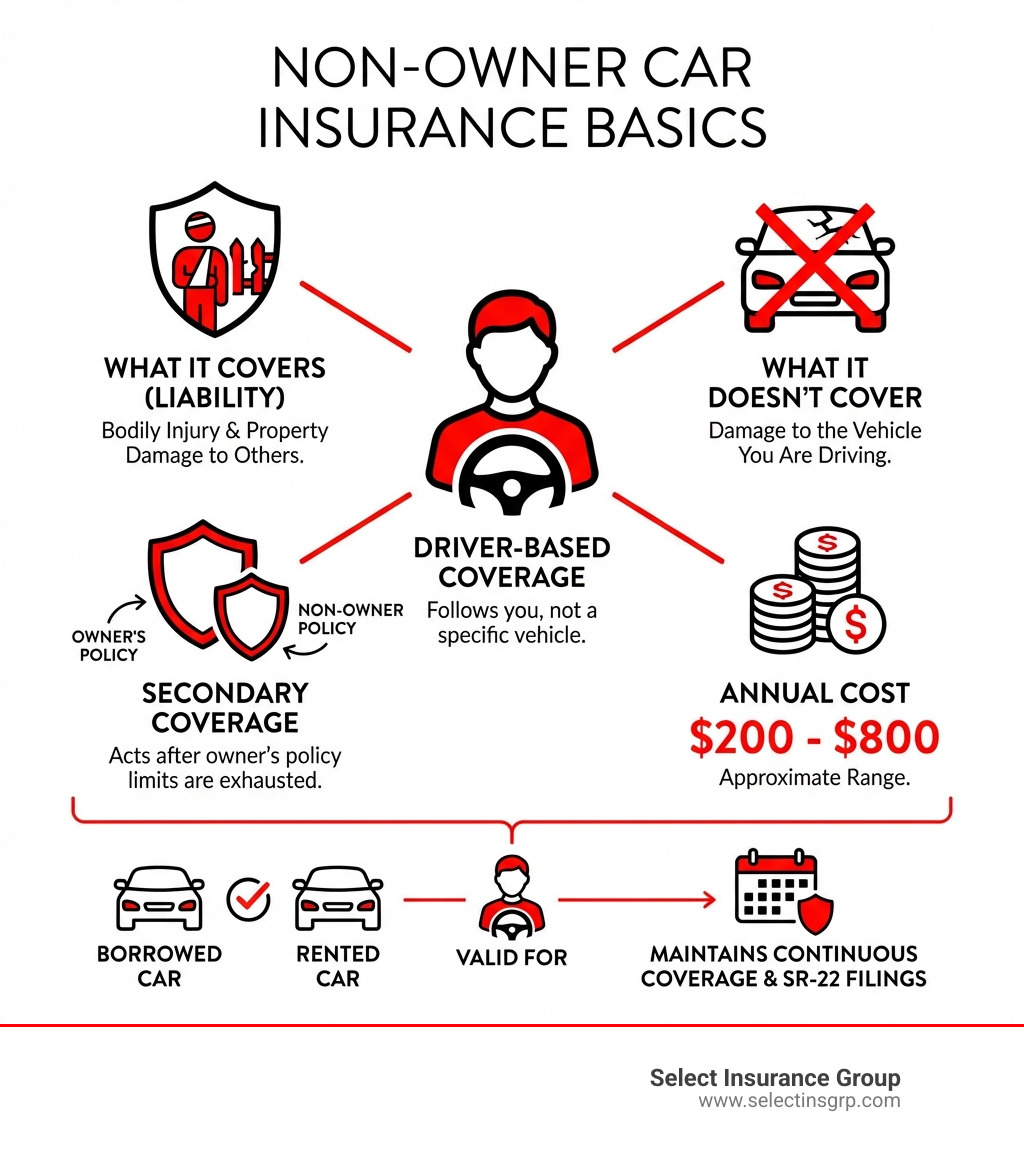
- What it is: Liability coverage that follows you, not a specific vehicle
- Who needs it: Frequent renters, car-sharing users, drivers maintaining continuous coverage, or those requiring SR-22 filings
- What it covers: Bodily injury and property damage you cause to others
- What it doesn’t cover: Damage to the vehicle you’re driving or your own injuries
- Average cost: $200-$800 per year (significantly less than standard auto insurance)
- How it works: Acts as secondary coverage after the car owner’s insurance limits are exhausted
Nearly every state requires drivers to carry liability coverage before they get behind the wheel. But not everyone who uses a driver’s license owns a car. If you don’t own a car and never drive, you aren’t legally required to have an auto insurance policy. However, if you regularly drive despite not having a vehicle, buying a policy makes financial sense to protect you from out-of-pocket expenses in case of an accident.
Whether you’re borrowing a friend’s car to run errands, renting vehicles for business trips, or using car-sharing services for your daily commute, non-owner insurance fills critical coverage gaps that could otherwise leave you financially exposed. It’s also essential for drivers who need to file an SR-22 to reinstate their license but don’t own a vehicle, or for those who want to maintain continuous coverage between cars to avoid future rate increases.
I’m D.J. Hearsey, founder and CEO of Select Insurance Group, where we’ve spent over three decades helping Southeastern drivers find the right coverage for their unique situations, including auto insurance for non car owners. My team and I work with more than 20 carriers to deliver competitive, transparent quotes and personalized service across all our locations.
Key terms for auto insurance for non car owners:
- cheap non drivers insurance
- getting liability insurance without a car
- getting sr22 insurance without a car
What is Non-Owner Car Insurance?
Non-owner car insurance, sometimes referred to as a “named non-owner policy,” is a form of liability coverage that protects you, the driver, rather than a specific vehicle. Unlike a standard auto policy that’s tied to a car you own, this policy follows you whenever you’re behind the wheel of a vehicle you don’t own. It’s designed to provide crucial financial protection by covering the damages and injuries you might cause to other people or their property in an at-fault accident.
This “driver-based coverage” is primarily focused on liability protection. This means it kicks in if you’re deemed responsible for an accident, covering:
- Bodily Injury Liability: This pays for medical expenses, lost wages, and pain and suffering for anyone you injure in an accident.
- Property Damage Liability: This covers the cost to repair or replace property you damage in an accident, such as another vehicle, a fence, or a building.
Essentially, a non-owner policy acts as a safety net, ensuring that your financial responsibility is covered when you’re driving a car that isn’t yours. It’s an important consideration for many individuals who find themselves frequently driving various vehicles without owning one themselves. For more detailed information, you can explore our guide on Getting Insurance Without a Car.
How Non-Owner Insurance Works
Understanding how non-owner insurance functions, especially in relation to other policies, is key. It typically operates as secondary coverage. What does this mean? If you’re driving a car you don’t own and get into an accident, the car owner’s primary insurance policy will usually be the first to respond. Their policy will pay out up to its liability limits.
However, if the damages and injuries you caused exceed the limits of the car owner’s policy, that’s where your non-owner policy steps in. It acts as a crucial layer of protection, covering the remaining costs up to your non-owner policy’s limits. This prevents you from being personally responsible for potentially massive out-of-pocket expenses.
Consider this example scenario: You borrow a friend’s car, and unfortunately, you’re involved in an at-fault accident that causes $75,000 in damages to another vehicle and injuries to its occupants. Your friend’s policy has a property damage limit of $25,000 and bodily injury limits of $25,000 per person/$50,000 per accident. Their policy would pay its maximum. If you have a non-owner policy with higher limits, say $50,000 property damage and $50,000 per person/$100,000 per accident for bodily injury, your non-owner policy would then cover the remaining $50,000 in damages and any additional bodily injury costs, ensuring your financial responsibility is met. This mechanism is why a non-owner policy is so valuable for managing potential financial exposure.
Key Differences from a Standard Policy
To truly grasp the value of auto insurance for non car owners, it’s helpful to compare it to a standard auto insurance policy. While both provide vital protection on the road, their fundamental structures and what they cover differ significantly.
Here’s a quick comparison:
| Aspect | Non-Owner Auto Insurance | Standard Auto Insurance |
|---|---|---|
| Vehicle Covered | None (covers the driver when driving any non-owned car) | Specific vehicle(s) owned by the policyholder |
| Primary Coverage | Secondary (kicks in after the owner’s policy) | Primary (first to respond in an accident) |
| Cost | Typically lower | Generally higher (insuring a specific vehicle and its value) |
| Included Coverages | Primarily liability (bodily injury, property damage), often with optional MedPay/PIP, UM/UIM | Liability, Collision, Comprehensive, MedPay/PIP, UM/UIM, Roadside Assistance, Rental Reimbursement |
The core distinction lies in what is being insured: a non-owner policy insures you, the driver, while a standard policy insures your car. This difference is reflected in the cost and the types of coverages included. Non-owner policies are generally more affordable because they don’t cover physical damage to a specific vehicle, which is often the most expensive part of a standard policy.
Who Needs a Non-Owner Policy (And Who Doesn’t)?
Navigating insurance can sometimes feel like a maze, especially when you don’t own a car. So, when does auto insurance for non car owners become a wise choice, and when can you safely skip it? It largely depends on your driving habits, any specific legal requirements you might face, and a careful cost-benefit analysis.
If you find yourself frequently behind the wheel of vehicles you don’t own, a non-owner policy can be an incredibly smart investment. It’s about protecting your financial future and maintaining a clean insurance record, even when you’re car-free.
Key Scenarios for Auto Insurance for Non Car Owners
There are several common situations where a non-owner policy isn’t just a good idea, but often a crucial one:
-
Frequent Renters & Borrowers: Do you often find yourself renting cars for business trips or vacations? Or perhaps you frequently borrow vehicles from friends, family, or use car-sharing services like Zipcar or Turo? If so, a non-owner policy can save you money and headaches. While rental companies offer their own liability coverage, it can easily cost $10-$15 per day, which adds up quickly. Your non-owner policy provides consistent liability protection, potentially making it a more cost-effective solution in the long run. Moreover, it provides an extra layer of protection beyond the car owner’s policy limits. As CNBC Select highlights, non-owner auto insurance can make sense depending on how frequently you rent cars because it could end up being cheaper than paying for the rental company’s liability each time. For more information, see What is non-owner auto insurance and when do you need it? .
-
Drivers Needing an SR-22/FR-44: If your driver’s license has been suspended due to a serious driving infraction (like a DUI/DWI or driving without insurance), many states will require you to file an SR-22 (or FR-44 in some states) to prove financial responsibility before your license can be reinstated. An SR-22 is not an insurance policy itself, but a certificate your insurer files with the state. If you don’t own a car, a non-owner policy is often the only way to satisfy this requirement and get back on the road legally. Our guide on Getting SR22 Insurance Without a Car provides more insights into this specific need.
-
Those Avoiding a Coverage Lapse: Life happens! Maybe you sold your car and are taking a break from ownership, or you’ve moved to a city with excellent public transportation. Even if you’re not driving regularly, maintaining continuous insurance coverage is incredibly beneficial. Insurers view drivers with gaps in coverage as higher risk, which can lead to significantly higher premiums when you eventually purchase a new policy. A non-owner policy provides an affordable way to keep your insurance history active, potentially qualifying you for continuous coverage discounts and avoiding future rate hikes. MoneyGeek points out that a lapse of 1-30 days can increase rates by an average of 25%, and longer than 30 days by 40%. A non-owner policy can prevent this costly scenario.
When You Might Not Need It
While non-owner car insurance offers valuable protection, it’s not for everyone. There are specific situations where you might not need to invest in such a policy:
-
Infrequent Driving: If you rarely get behind the wheel of a non-owned vehicle—perhaps once or twice a year for a special occasion—the cost of a non-owner policy might outweigh the benefits. In such cases, relying on the car owner’s policy or purchasing minimal rental company liability for very occasional rentals might suffice. KBB.com suggests that if you only rent a car once a year for vacation, getting coverage from the rental company might be best.
-
Household Members & Permissive Use: If the only non-owned car you drive belongs to a family member or roommate with whom you live, a non-owner policy is generally not the right solution. Most standard auto insurance policies require all licensed drivers in a household to be listed on the policy. If you regularly drive a vehicle owned by someone in your household, you should be added to their policy. This ensures you’re adequately covered by the primary policy, and it’s usually a requirement by the insurer. A non-owner policy is typically for vehicles you don’t have regular access to.
-
Company Vehicles: If your primary driving consists of operating a company-issued vehicle, your employer’s commercial insurance policy should provide coverage. In this scenario, a non-owner policy for personal use might be redundant, though some individuals consider a “drive other car” endorsement for added personal liability protection.
For a comprehensive guide on whether you need insurance when you don’t own a car, refer to If I Don’t Have a Car, Do I Need Auto Insurance? .
Understanding Your Coverage: What’s Included and What’s Not
When considering auto insurance for non car owners, it’s crucial to understand the specifics of what a policy typically covers and, equally important, what its limitations are. Knowing these details will help you set appropriate coverage limits and determine if any additional protection is needed.
What a Non-Owner Policy Typically Covers
The core of any non-owner policy is liability coverage, which includes:
- Bodily Injury Liability: This pays for medical expenses, lost wages, and pain and suffering for others if you’re at fault in an accident.
- Property Damage Liability: This covers repairs or replacement costs for property you damage, such as other vehicles, fences, or buildings.
Beyond the fundamental liability coverage, many non-owner policies also offer optional coverages that can significantly improve your protection:
- Medical Payments (MedPay): This coverage helps pay for medical expenses for you and your passengers, regardless of who was at fault in an accident. It’s a great way to ensure that immediate medical costs are covered.
- Personal Injury Protection (PIP): Similar to MedPay, PIP covers medical expenses, lost wages, and other related costs for you and your passengers, regardless of fault. The availability and specifics of PIP vary by state, particularly in “no-fault” states.
- Uninsured/Underinsured Motorist (UM/UIM) Coverage: This is a vital add-on that protects you if you’re involved in an accident with a driver who either has no insurance (uninsured) or not enough insurance (underinsured) to cover your damages and injuries. This can also extend to you as a pedestrian or cyclist hit by an uninsured driver in some cases, as highlighted by State Farm’s “Personal Mobility Coverage.”
These optional coverages transform a basic liability policy into a more robust safety net, providing peace of mind knowing you’re protected from various angles.
What are the limitations of auto insurance for non car owners?
While incredibly useful, auto insurance for non car owners does have specific limitations that are important to acknowledge. Unlike a standard policy that covers a vehicle you own, a non-owner policy does not cover:
- Damage to the Driven Vehicle: This is perhaps the most significant limitation. If you’re driving a borrowed or rented car and you cause an accident, your non-owner policy will not pay for repairs to that vehicle. This means it doesn’t include:
- Collision coverage: Which would pay for damages to the car you’re driving if you hit another object or vehicle.
- Comprehensive coverage: Which covers damages to the car you’re driving from non-collision events like theft, vandalism, fire, or natural disasters.
If you want physical damage protection for a rental car, you would need to purchase a Collision Damage Waiver (CDW) or similar coverage directly from the rental company or rely on coverage from a credit card.
- Your Own Injuries (if MedPay/PIP isn’t added): While liability covers others’ injuries, your own medical bills wouldn’t be covered unless you’ve opted for MedPay or PIP as an add-on.
- Personal Belongings: Any personal items inside the vehicle (e.g., laptop, luggage) that are damaged or stolen are not covered by a non-owner policy. This would typically fall under your homeowner’s or renter’s insurance.
- Towing and Labor: Costs associated with towing the damaged vehicle or roadside assistance are generally not included.
- Business Use: Non-owner policies are typically for personal use. If you’re driving a non-owned vehicle for commercial purposes (e.g., ridesharing, delivery services), you would need specialized commercial insurance.
Understanding these limitations helps you make informed decisions about whether to purchase additional coverage, especially when renting vehicles.
The Cost of Coverage and How to Get Auto Insurance for Non Car Owners
One of the most appealing aspects of auto insurance for non car owners is its affordability compared to a traditional policy. Because it doesn’t cover a specific vehicle’s physical damage, the premiums are significantly lower. However, the exact cost can vary.
Factors That Influence Your Premium
While non-owner policies are generally more budget-friendly, several factors still play a role in determining your specific premium:
- Driving Record: This is paramount. A clean driving record with no accidents or violations will result in much lower rates. Conversely, a history of tickets or accidents will increase your premium.
- Location: Where you live and drive significantly impacts your rates. Urban areas with higher traffic density and crime rates typically have higher premiums than rural areas. For instance, in New York, average annual non-owner car insurance rates in New York City could be around $950, while in Albany, they might be $650.
- Age: Younger drivers, particularly those under 25, are statistically considered higher risk and will generally face higher premiums. For example, in New York, an 18-year-old might pay around $1,100 annually, while a 50-year-old could pay closer to $500.
- Coverage Limits Chosen: Opting for higher liability limits (e.g., $100,000/$300,000 bodily injury instead of state minimums) will increase your premium, but it also provides greater financial protection.
- Credit History (in some states): In many states, insurers use an insurance-based credit score to help determine rates. A good credit history can lead to lower premiums.
What does it typically cost?
The national average for non-owner auto insurance coverage is around $748 annually, though some insurers offer options as low as $202 per year. You can expect to pay about $800 annually for a policy. For minimum liability coverage, some providers offer policies for around $575 per year. These are averages, and your specific rate will depend on the factors above.
How to Obtain a Policy
Getting auto insurance for non car owners is a straightforward process, but it may require a bit more legwork than purchasing a standard policy online, as not all insurers offer it, or they might not offer online quotes for it.
Here’s how we at Select Insurance Group recommend you proceed:
- Gather Personal Information: Have your driver’s license number, driving history (any accidents or tickets), and personal details (name, address, date of birth) ready.
- Contact an Independent Insurance Agent: This is where we shine! As an independent agency, Select Insurance Group works with over 20 carriers. This means we can shop around on your behalf to find providers that offer non-owner policies and compare quotes to get you the best coverage at the most competitive rates. Many companies may only offer non-owner coverage by phone or through an agent, so working with us simplifies the process. You can refer to our Getting Liability Insurance Without Car Guide for more details.
- Compare Quotes: Don’t settle for the first quote you receive. We’ll help you compare premiums, coverage limits, and any optional coverages to ensure you’re getting the best value for your needs.
- Review Policy Terms: Once you’ve selected a policy, carefully review all the terms and conditions. Understand exactly what’s covered, what’s excluded, and your responsibilities as the policyholder.
By following these steps, you can confidently obtain the non-owner car insurance that fits your unique driving situation.
Frequently Asked Questions
We often hear similar questions from our clients about auto insurance for non car owners. Let’s address some of the most common ones to provide even greater clarity.
Is non-owner car insurance cheaper than a standard policy?
Yes, absolutely! Non-owner car insurance is typically significantly cheaper than a standard auto insurance policy. Why the price difference? It boils down to risk. A standard policy covers a specific vehicle, including its potential for physical damage (collision and comprehensive coverage), which is often the most expensive part of a policy.
With a non-owner policy, there’s no specific vehicle to insure for physical damage. It primarily focuses on liability—the damage and injuries you might cause to others. Insurers also view non-owner policyholders as less risky because they generally drive less frequently than car owners. This combination results in lower premiums. While a standard policy can easily cost well over $1,000 annually, the national average for non-owner coverage is around $748 per year, with some options as low as $202.
Does non-owner insurance cover rental cars?
Yes, a non-owner policy is an excellent option for covering rental cars, specifically for liability. If you’re driving a rental car and cause an accident, your non-owner policy will provide the necessary bodily injury and property damage liability coverage. This means it will pay for the damages and injuries you inflict on other people or their property.
However, it’s crucial to remember a key limitation: your non-owner policy will not cover physical damage to the rental car itself. For that, you would need to purchase a Collision Damage Waiver (CDW) or Loss Damage Waiver (LDW) from the rental car company. Alternatively, some credit cards offer secondary rental car insurance that covers physical damage to the rental vehicle if you use that card to pay for the rental. For frequent renters, a non-owner policy can be more cost-effective than repeatedly buying the rental company’s liability insurance, which can add $10-$15 per day to your rental cost.
Can I get a policy if I live with someone who owns a car?
Generally, no, you cannot get a non-owner policy if you live with someone who owns a car and you regularly drive that vehicle. Insurance companies typically require that all licensed drivers residing in a household be listed on the primary auto insurance policy for any vehicles kept at that residence. This is because insurers want to know all potential drivers of a covered vehicle to accurately assess risk.
If you regularly drive a car owned by a household member, the expectation is that you should be added to their existing policy as a named driver. Obtaining a non-owner policy in this situation would likely be seen as an attempt to circumvent the insurer’s requirements and could lead to issues if a claim were filed. Non-owner insurance is designed for those who drive vehicles they don’t have regular access to, like frequently borrowed cars from friends, rentals, or car-sharing services, not for vehicles in their own household.
Conclusion: Drive with Confidence, Even Without a Car
When car ownership isn’t always a given, auto insurance for non car owners stands out as a vital, often overlooked, financial safety net. As we’ve explored, this specialized liability-only coverage provides crucial protection for licensed drivers who frequently borrow, rent, or share vehicles, or who need to maintain continuous coverage for future benefits.
It’s a smart choice for those navigating the complexities of SR-22 requirements, seeking to avoid costly coverage lapses, or simply wanting peace of mind when driving a car that isn’t their own. While it doesn’t cover physical damage to the vehicle you’re driving, its core liability protection shields you from potentially devastating financial responsibility for injuries or property damage you might cause to others.
At Select Insurance Group, we understand that your driving needs are unique. We pride ourselves on offering personalized solutions, leveraging our decades of experience and partnerships with numerous carriers to find the right coverage for you. Don’t let uncertainty leave you exposed on the road. For a personalized quote on your auto insurance needs in North Carolina, contact us today, and let us help you drive with confidence.