
Why Florida Automobile Insurance is More Complex Than Most States
Florida automobile insurance requires all drivers to carry a minimum of $10,000 in Personal Injury Protection (PIP) and $10,000 in Property Damage Liability (PDL) to legally register and operate a vehicle. Here’s what makes Florida different:
- No-fault state: Your PIP covers your medical expenses regardless of who caused the accident
- No bodily injury liability requirement: Unlike most states, BIL is optional for private vehicles
- Continuous coverage mandatory: Insurance must remain active throughout your registration period
- Severe penalties: Driving uninsured can result in license suspension for up to 3 years and a $500 reinstatement fee
Florida is one of only 12 states that follow a no-fault insurance system, which fundamentally changes how claims work compared to traditional tort liability states. Instead of determining fault before covering medical expenses, your own PIP coverage pays first—up to 80% of necessary medical costs, capped at $10,000.
This system exists because Florida has one of the highest accident rates in the nation. In 2021 alone, the state recorded 3,451 fatal accidents, and over 20% of Florida drivers are estimated to be uninsured. These risk factors contribute to Florida’s average car insurance cost of $3,682 per year for full coverage—68% higher than the national average.
Understanding these requirements isn’t just about staying legal. It’s about protecting yourself financially in a state where the odds of an accident are higher than most places in America.
I’m D.J. Hearsey, founder and CEO of Select Insurance Group, where I’ve spent over three decades helping drivers across the Southeast steer complex florida automobile insurance requirements and find affordable coverage that actually protects them. Through our 12 locations and relationships with more than 40 carriers, I’ve seen how the right coverage can make all the difference when the unexpected happens.
Florida automobile insurance further reading:
Mandatory Florida Automobile Insurance Requirements
In the Sunshine State, the law is very specific about what you need before you can even get your shiny new license plate. Before you register any vehicle with at least four wheels, you must show proof of florida automobile insurance from a company licensed to do business in the state.

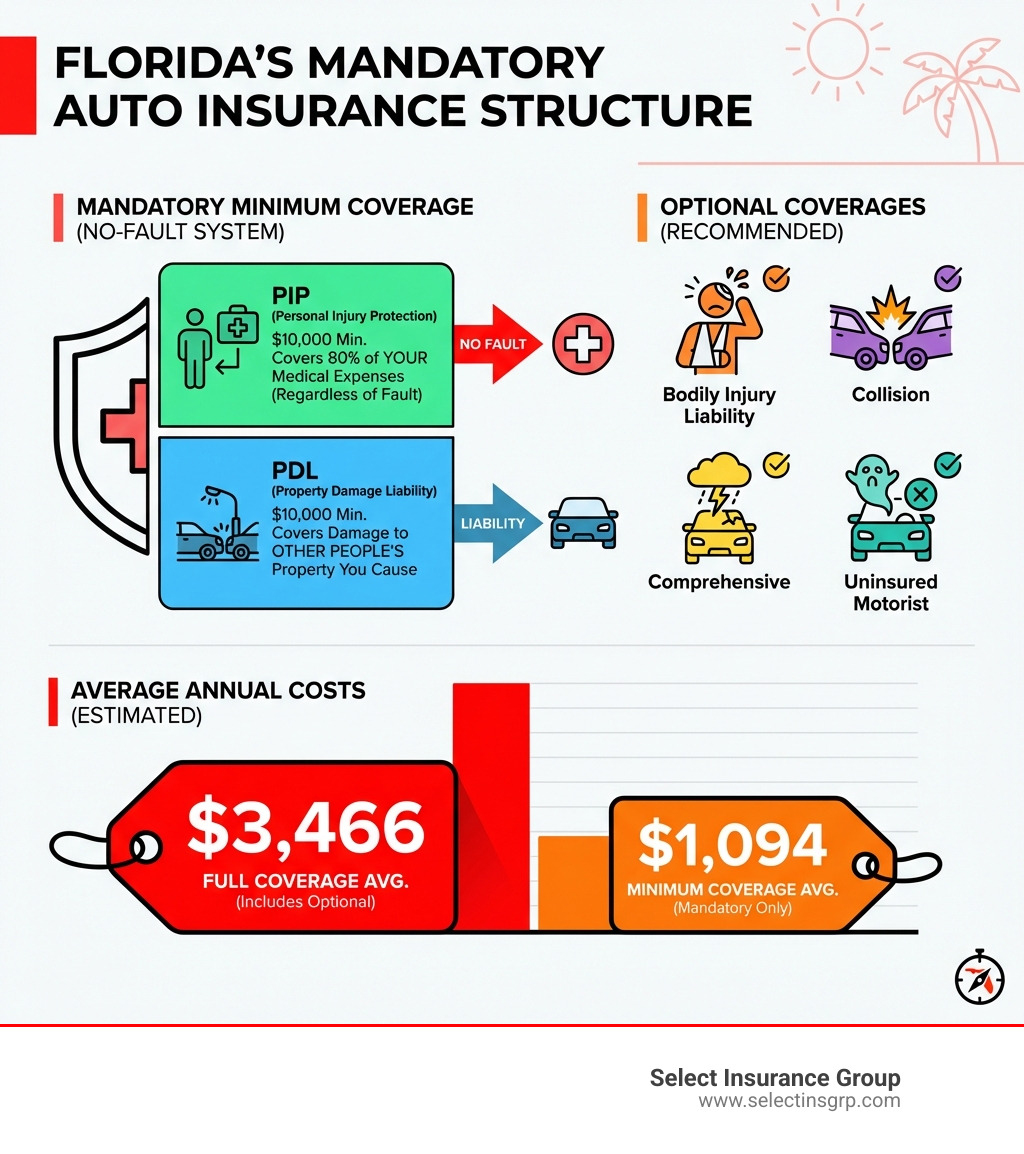
The bare essentials are often referred to as “10/10” coverage. This means you must carry a minimum of $10,000 in Personal Injury Protection (PIP) and $10,000 in Property Damage Liability (PDL). While this gets you legal, we often tell our clients that these minimum requirements are just a starting point. If you want to dive deeper into the official rules, the Florida Insurance Requirements page from the DHSMV is the definitive source.
Personal Injury Protection (PIP)
Often called “Florida No-Fault Insurance,” PIP is designed to reduce the number of lawsuits in the court system by having everyone take care of their own medical bills. Here is how the math works: PIP covers 80% of all necessary and reasonable medical expenses up to the $10,000 limit.
It doesn’t matter if you were the one who accidentally took a turn too wide or if someone else hit you; your PIP is the first line of defense. Beyond medical bills, it also covers 60% of lost wages if you can’t work due to the injury and provides death benefits to survivors.
Property Damage Liability (PDL)
While PIP looks after you, PDL looks after the other person’s stuff. If you are at fault in an accident, your PDL coverage pays for damage to another person’s property. This usually means their car, but it also covers things like fences, lamp posts, or even a storefront if you have a really bad day. The state requires a minimum of $10,000, which, as we’ll discuss later, can vanish very quickly if you happen to bump into a brand-new luxury SUV.
Navigating the No-Fault System and State Laws
Florida is one of only 12 states in the country that uses a no-fault system. In a “Tort” state (the other 38 states), the person who caused the accident is responsible for all damages. In Florida, we share the load a bit differently.
| Feature | Florida No-Fault System | Standard Tort System |
|---|---|---|
| Medical Bills | Your own PIP pays first | At-fault driver’s insurance pays |
| Right to Sue | Restricted by “Tort Threshold” | Generally unrestricted |
| Property Damage | At-fault driver pays (via PDL) | At-fault driver pays |
| Mandatory BIL | Not required for private cars | Almost always mandatory |
Understanding these Florida auto laws is crucial for anyone moving here from out of state.
Why Florida Automobile Insurance is Unique
The most surprising thing for newcomers is that Bodily Injury Liability (BIL)—which pays for injuries you cause to others—is technically optional for most private passenger vehicles. However, there’s a catch. If you cause an accident that results in “permanent injury,” you lose your legal immunity under the no-fault system and can be sued for the remaining medical expenses and pain and suffering. This is why we almost always recommend adding BIL to your florida automobile insurance policy.
Continuous Coverage Rules
Florida doesn’t allow for “seasonal” insurance gaps. You must maintain continuous coverage on your vehicle as long as it has a valid Florida registration. This applies even if the car is sitting in a garage, is inoperable, or if you are out of the state for months at a time. The only exception is for certain military members stationed out of state. If you plan to stop driving, you must surrender your license plate before you cancel your insurance.
For more details on maintaining your status, check the official Florida Insurance Requirements portal.
Beyond the Basics: Optional Coverage and Average Costs
While the state only requires PIP and PDL, “minimum” rarely means “enough.” If you only have the basics and get into a serious wreck, you could be left with massive out-of-pocket expenses.
Maximizing Your Florida Automobile Insurance with Optional Add-ons
To truly protect your assets, you should consider a Full Coverage policy. Here are the most common additions:
- Bodily Injury Liability (BIL): Pays for serious and permanent injury or death to others when you are at fault.
- Uninsured Motorist (UM): This is vital in Florida, where over 20% of drivers have no insurance. It covers you if you’re hit by someone who doesn’t have enough coverage.
- Collision: Pays for repairs to your car after an accident, regardless of fault.
- Comprehensive: Covers non-collision events like theft, vandalism, fire, or the dreaded Florida floodwaters.
- Medical Payments (MedPay): Covers the 20% of medical bills that PIP leaves behind.
If you’re looking for the best value, we have a guide on finding cheap Florida insurance that doesn’t skimp on the essentials.
Understanding Average Premiums in the Sunshine State
Let’s talk numbers. Florida is expensive. According to 2024 data, the average cost of florida automobile insurance is roughly $3,682 annually for full coverage.
- Full Coverage Average: $3,466 – $3,682 per year.
- Minimum Coverage Average: $1,094 per year.
Why so high? It’s a “perfect storm” of factors: high population density in cities like Miami and Tampa, frequent severe weather (hurricanes), and a high rate of uninsured drivers. In fact, Florida’s rates are about 68% higher than the national average.
Penalties for Non-Compliance and Non-Resident Rules
Florida takes its insurance laws very seriously. The Department of Highway Safety and Motor Vehicles (FLHSMV) receives electronic updates from insurance companies. If your policy lapses, they know almost immediately.
Consequences of Driving Uninsured
If you are caught driving without florida automobile insurance, or if your insurer notifies the state of a cancellation, you face:
- License and Plate Suspension: Your driving privilege can be suspended for up to three years.
- Reinstatement Fees: You’ll have to pay $150 for the first offense, $250 for the second, and $500 for the third (within a 3-year period).
- No Hardship Licenses: Unlike some other violations, there are no “hardship” or “work-only” licenses available for insurance-related suspensions.
- SR-22 Filing: You may be required to have an SR-22 (a certificate of financial responsibility) for three years, which significantly raises your premiums.
You can read more about how to steer these agencies in our Florida auto insurance agency guide.
Requirements for Non-Residents and New Arrivals
If you’ve just moved to Florida, the clock is ticking. You must obtain a Florida registration and insurance within 10 days of:
- Starting employment in Florida.
- Enrolling your children in a Florida public school.
Even if you are a “snowbird” and only live here part-time, if you keep a car in the state for more than 90 days (even if those days aren’t consecutive), you generally need to register it here and meet Florida’s insurance minimums.
Filing a Claim and Saving Money on Your Policy
Filing a claim in a no-fault state can feel a bit counter-intuitive. Because your own insurance pays for your medical bills first, you’ll be dealing with your own carrier much more than the other person’s.
How to File an Auto Insurance Claim
- Call Law Enforcement: A police report is vital for documenting the scene.
- Exchange Info: Get the other driver’s name, address, and insurance details.
- Document Everything: Take photos of the damage and the surrounding area.
- Notify Your Insurer: Florida law requires insurers to provide a 45-day notice for cancellation (10 days for non-payment), so ensure your policy was active at the time of the incident.
- Consider Mediation: If you and your insurer can’t agree on a settlement, Florida offers a mediation program to resolve disputes without going to court.
Strategies for Lowering Your Premium
Just because Florida has high averages doesn’t mean you have to pay the maximum. Here are our top tips for finding low cost insurance:
- Shop Around: At Select Insurance Group, we shop over 40 carriers because rates can vary by hundreds of dollars for the exact same driver.
- Bundle Policies: Combining your auto and homeowners insurance can save you up to 25%.
- Telematics Programs: Programs like “RightTrack” or “DynamicDrive” can save you up to 30% if you’re a safe driver.
- Maintain Your Credit: In Florida, your credit score heavily influences your insurance rate.
- Discounts: Look for multi-car, defensive driving course, and student discounts.
Frequently Asked Questions about Florida Auto Insurance
What should I do with my insurance if I move out of state?
Whatever you do, do not cancel your Florida insurance first. You must surrender your Florida license plates and registration to a local tax collector’s office or driver’s license office before you cancel the policy. If you cancel first, Florida may suspend your license, which will follow you to your new state and prevent you from getting a new license there.
Is Bodily Injury Liability (BIL) required for all vehicles?
While optional for most cars, BIL is mandatory for certain vehicles. For example, taxis are required to carry BIL of $125,000 per person and $250,000 per occurrence, along with $50,000 in PDL. Additionally, if you’ve been involved in a serious accident or have certain violations (like a DUI), the state may mandate BIL through the Financial Responsibility Law.
How does the Florida windshield replacement law work?
Florida law is very “pro-safety” when it comes to glass. If you have comprehensive coverage, Florida Statute 501.32 requires insurers to waive the deductible for windshield repair or replacement. This means you can get your cracked windshield fixed for $0 out of pocket, encouraging drivers to keep their vision clear on the road.
Conclusion
Navigating florida automobile insurance doesn’t have to be a headache. While the state’s no-fault system and high premiums present unique challenges, understanding the difference between what’s mandatory and what’s necessary is the first step toward true financial security.
At Select Insurance Group, we’ve spent over 30 years helping Florida residents find the perfect balance of protection and price. We don’t just work for one company; we shop over 40 different carriers to make sure you’re getting the most competitive rate available. Whether you’re in the Panhandle or the Keys, our team is ready to help you decode your policy.
Ready to see how much you could save? Reach out to our Tampa agency today for a personalized quote and let us do the heavy lifting for you. Safe driving!