Why Jacksonville Truckers Need the Right Coverage
Commercial truck insurance Jacksonville FL is required coverage for any trucking operation moving freight through Florida’s busiest port city, whether you’re running interstate routes or making local deliveries. At minimum, you need primary liability coverage ranging from $750,000 to $1 million depending on your cargo and weight class, plus physical damage protection if you’re financing your rig. Most owner-operators in Jacksonville spend $8,000 to $18,000 per year for a standard $1 million liability policy, with new authorities often paying 20-40% more until they build a clean safety record.
Quick Overview: What You Need to Know
- Mandatory coverage: Primary liability ($750k-$1M minimum for interstate)
- Typical annual cost: $8,000-$18,000 per truck in Jacksonville
- Common add-ons: Physical damage, cargo ($100k standard), general liability
- Key filings: MCS-90 endorsement, Form E (if hauling certain commodities)
- New authorities: Expect $12,000-$25,000+ first year
- Ways to save: Telematics, dash cams, higher deductibles, clean MVR
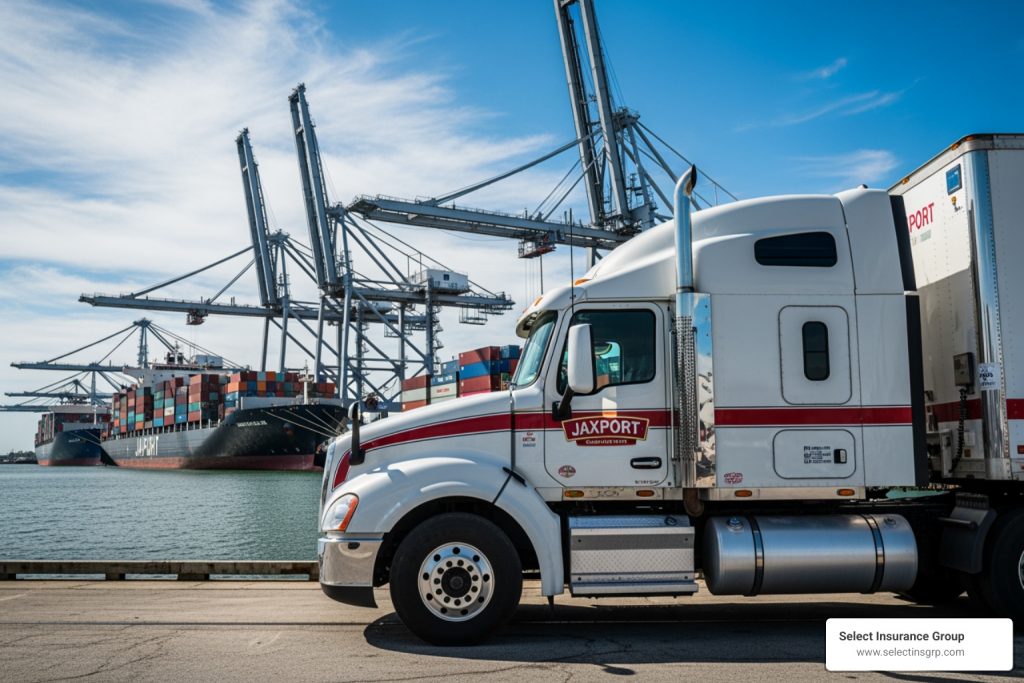
Jacksonville sits at the intersection of I-95 and I-10, with direct access to JAXPORT—one of the nation’s top container and vehicle ports. That means trucks here haul everything from agricultural exports and military equipment to high-value electronics and refrigerated goods. The variety of freight, combined with Florida’s unique weather risks and heavy traffic corridors, makes choosing the right insurance mix critical for protecting both your rig and your business.
I’m D.J. Hearsey, founder and CEO of Select Insurance Group, and for over three decades I’ve helped trucking businesses across the Southeast—including Jacksonville—navigate commercial truck insurance Jacksonville FL options that fit their routes, cargo, and budgets. In this guide, we’ll break down exactly what coverage you need, what it costs, and how to get the best rates without sacrificing protection.
Quick commercial truck insurance jacksonville fl definitions:
Navigating Commercial Truck Insurance Jacksonville FL

When you are rumbling down I-10 or shifting gears through the busy streets of Five Points, you aren’t just driving a vehicle; you are operating the lifeblood of your business. In Jacksonville, the stakes are high. One accident on the Buckman Bridge or a cargo theft at a truck stop can derail your entire operation. This is where asset protection meets financial security.
Commercial truck insurance Jacksonville FL serves as your financial defense. It isn’t just about satisfying a legal requirement; it’s about ensuring that if the unexpected happens—whether it’s a collision, a hurricane-force windstorm, or a lawsuit—your business doesn’t go under. For many of our clients, their truck is their most valuable asset. Protecting that asset requires a deep understanding of Florida commercial insurance.
Risk management in “Jax” is unique. We deal with high traffic volume from JAXPORT and the frequent transit of heavy freight along the I-95 corridor. This constant movement increases the likelihood of incidents, making comprehensive truck car insurance an absolute necessity for anyone from a single owner-operator to a large motor carrier.
Mandatory and Recommended Coverage Types
Navigating the sea of insurance options can feel like trying to navigate a container ship through a narrow canal. To make it easier, we have broken down the “must-haves” versus the “should-haves.”
| Coverage Type | Status | What it Does |
|---|---|---|
| Primary Liability | Mandatory | Covers bodily injury and property damage to others. |
| Physical Damage | Recommended* | Covers repair or replacement of your truck/trailer. |
| Motor Truck Cargo | Recommended** | Protects the freight you are hauling from loss or damage. |
| General Liability | Recommended | Covers non-driving risks (slip and falls, etc.). |
| Bobtail/NTL | Recommended*** | Covers you when you aren’t under dispatch. |
*Required by lenders if the truck is financed. *Required by most shippers and load boards.* **Essential for leased-on owner-operators.*
Truck liability coverage is the foundation of your policy. For interstate haulers, the FMCSA mandates minimums between $750,000 and $5 million, depending on what you are carrying. If you’re hauling general freight, $750,000 is the floor, but most brokers won’t even look at you unless you carry at least $1 million.
Understanding the Cost of Commercial Truck Insurance Jacksonville FL
Let’s talk numbers. We know the first thing you probably did was search for the average truck insurance cost. In Jacksonville, the typical range for a standard $1 million liability policy is $8,000 to $18,000 per truck, per year. If you break that down, you’re looking at roughly $665 to $1,500 per month.
Why the big gap? Several factors influence your premium:
- Radius of Operation: If you stay within Florida (intrastate), your rates might be lower than a long-haul driver crossing state lines.
- Driving History: A clean MVR (Motor Vehicle Record) is gold. Accidents and tickets will spike your rates.
- Credit Score: In Florida, insurance companies often use credit-based insurance scores to determine risk.
- Experience: If you have less than two years of CDL experience, expect to pay a premium for that “new driver” status.
Essential Cargo Protection
If you’re picking up a load at JAXPORT, the shipper is going to want to see proof of cargo insurance for truckers. While the FMCSA only mandates cargo insurance for household goods movers, the reality of the industry is that you need it.
A standard limit is $100,000 per load, but if you are hauling high-value electronics or pharmaceuticals, you’ll need more. One specific thing to watch for in Jacksonville is reefer breakdown coverage. With our Florida heat, a cooling unit failure can ruin a load of produce or seafood in minutes. Your cargo policy should specifically include endorsements for mechanical breakdown of the refrigeration unit to protect you from these losses.
Getting a Quote for Commercial Truck Insurance Jacksonville FL
Ready to see what your specific rates look like? When you come to us to get a quote, having your paperwork ready will speed up the process. We’ll need:
- Your DOT and MC numbers.
- A list of all drivers and their CDL numbers.
- VINs for all trucks and trailers, along with their stated values.
- Your “loss runs” (a three-year history of any previous insurance claims).
- Your typical operating radius and the types of cargo you haul.
Regulatory Requirements and Filings in Florida
Trucking is one of the most regulated industries in the country. If your filings aren’t in order, you aren’t moving. In Florida, we deal with both state and federal requirements.
For interstate carriers, the MCS-90 endorsement is vital. It’s a public liability endorsement that ensures the insurer will pay for damages even if the specific incident isn’t covered by the policy terms (though they will come back to you for reimbursement). You also have the BMC-91X, which is the electronic filing made to the FMCSA proving you have the required liability limits.
For those staying within state lines, you’ll need to be familiar with the Florida DOT Official Site for local registration and compliance. If your routes take you north, keep an eye on the Georgia DOT Official Site as well, as interstate travel requires strict adherence to federal standards. Filings like Form E and Form H are often required to certify that you meet state-specific financial responsibility laws.
Strategies to Lower Your Trucking Premiums
We know that insurance is one of your biggest fixed costs. While you can’t control the price of diesel, you can take steps to lower your premiums.
- Embrace Technology: Installing telematics and dash cameras can lead to significant discounts. Many insurers see this as a sign of a proactive safety culture.
- Safety Programs: Join a formal safety or maintenance program. Keeping your CSA (Compliance, Safety, Accountability) scores low is one of the best ways to qualify for preferred rates.
- Higher Deductibles: If you have the cash reserves to handle a $2,500 or $5,000 deductible instead of $1,000, you will see a noticeable drop in your monthly premium.
- Pay Annually: If you can swing the up-front cost, paying your full annual premium instead of monthly installments can save you 10% or more in finance fees.
- Experience Matters: Rates typically drop significantly once you have passed the two-year mark of having your own authority and a clean record.
Don’t forget about Florida workers compensation. While Florida statutes sometimes exclude owner-operators from mandatory workers’ comp, many brokers require it—or an Occupational Accident policy—before they will give you a load.
Frequently Asked Questions about Jacksonville Trucking
What is the difference between Bobtail and Non-Trucking Liability?
This is a common point of confusion for leased-on operators.
- Bobtail Insurance covers you when you are driving the tractor without a trailer attached, regardless of whether you are “on the clock.”
- Non-Trucking Liability (NTL) is more specific. It covers you for “personal use” when you aren’t under dispatch. If you are “deadheading” (pulling an empty trailer) back from a drop-off, NTL usually won’t cover you, but your carrier’s primary liability might.
Understanding these nuances is a key part of owner operator semi truck insurance.
Why is Jacksonville a unique hub for truck insurance?
Jacksonville is the largest city by land area in the contiguous U.S., and it’s built for logistics. Between JAXPORT, the intermodal rail ramps, and the massive distribution centers for companies like Amazon, the variety of risks is huge. You might be hauling military equipment one day and citrus the next. This diversity requires a flexible Florida business auto insurance policy that can adapt to changing cargo and routes.
How do new authorities impact insurance rates?
If you just got your MC number, congratulations! But be prepared for “sticker shock.” Carriers with under two years of operating authority are considered “new ventures.” Because you don’t have a proven track record of safety, insurers often apply a 20-40% surcharge.
New long-haul authorities in Jacksonville can see premiums ranging from $12,000 to $25,000+. The goal for the first two years is to stay safe, keep your inspections clean, and build a history that allows us to move you to a preferred carrier later. This is where Florida general liability also comes into play to protect your new business from non-road risks.
Conclusion
At Select Insurance Group, we understand that you aren’t just looking for a piece of paper that says “insured.” You are looking for a partner who understands the Jacksonville market and the pressures of the trucking industry. With over 30 years of experience and access to more than 40 carriers, we don’t just give you a quote—we shop the market to find the best possible fit for your specific needs.
Whether you are a new venture looking to get your first load or an established fleet looking to trim costs, we are here to help. Our team is dedicated to providing personalized service, fast certificates of insurance, and the expert advice you need to keep your wheels turning.
Ready to secure your business? Protect your business with Florida commercial insurance by reaching out to us today. Let’s get you covered so you can focus on the road ahead.