What “Full Coverage Non-Owner Insurance” Really Means (And Why It Matters)
Full coverage non owners insurance is a type of auto policy that protects you when you drive a car you don’t own — covering your liability and optional protections like medical payments and uninsured motorist coverage.
Here’s a quick breakdown of what it typically includes:
| Coverage Type | What It Does |
|---|---|
| Bodily Injury Liability | Pays for injuries you cause to others |
| Property Damage Liability | Covers damage you cause to someone else’s property |
| Medical Payments (MedPay) | Helps cover your own medical bills after an accident |
| Uninsured/Underinsured Motorist | Protects you if the other driver has little or no insurance |
| Personal Injury Protection (PIP) | Covers medical costs and lost wages (in select states) |
Important: No non-owner policy covers physical damage to the vehicle you’re driving. That’s the key limitation — and one most people don’t realize until it’s too late.
Not everyone needs a car to need insurance. If you regularly borrow cars, rent vehicles, or use car-sharing services in states like Florida, Georgia, the Carolinas, or Virginia — a gap in your coverage could leave you personally responsible for thousands of dollars after an accident.
I’m D.J. Hearsey, founder of Select Insurance Group, and with over 30 years of combined industry experience helping Southeast US drivers find the right coverage, I’ve guided countless clients through the nuances of full coverage non owners insurance — from understanding what it actually protects to finding the most affordable options across 20+ carriers. In this guide, I’ll break down everything you need to know so you can make a confident, informed decision.
Key full coverage non owners insurance vocabulary:
- hired and non owned automobile coverage
- getting sr22 insurance without a car
- liability for damage to non owned automobile
What is Full Coverage Non Owners Insurance?

When we talk about full coverage non owners insurance, we are entering a bit of a “gray area” in insurance terminology. In standard auto insurance, “full coverage” usually implies that you have liability plus collision and comprehensive protection. However, in the context of someone who doesn’t own a car, the definition shifts.
At its core, a non-owner policy is a liability-based contract. It is designed for individuals who have a valid driver’s license but do not have a vehicle registered in their name. This policy follows the driver, not the vehicle.
Many people ask, Is There Such a Thing as Non-Owner Auto Insurance? The answer is a resounding yes, but with specific nuances. While a standard non-owner policy only meets state minimum liability requirements, a “full coverage” version adds layers of personal protection like medical payments and uninsured motorist coverage.
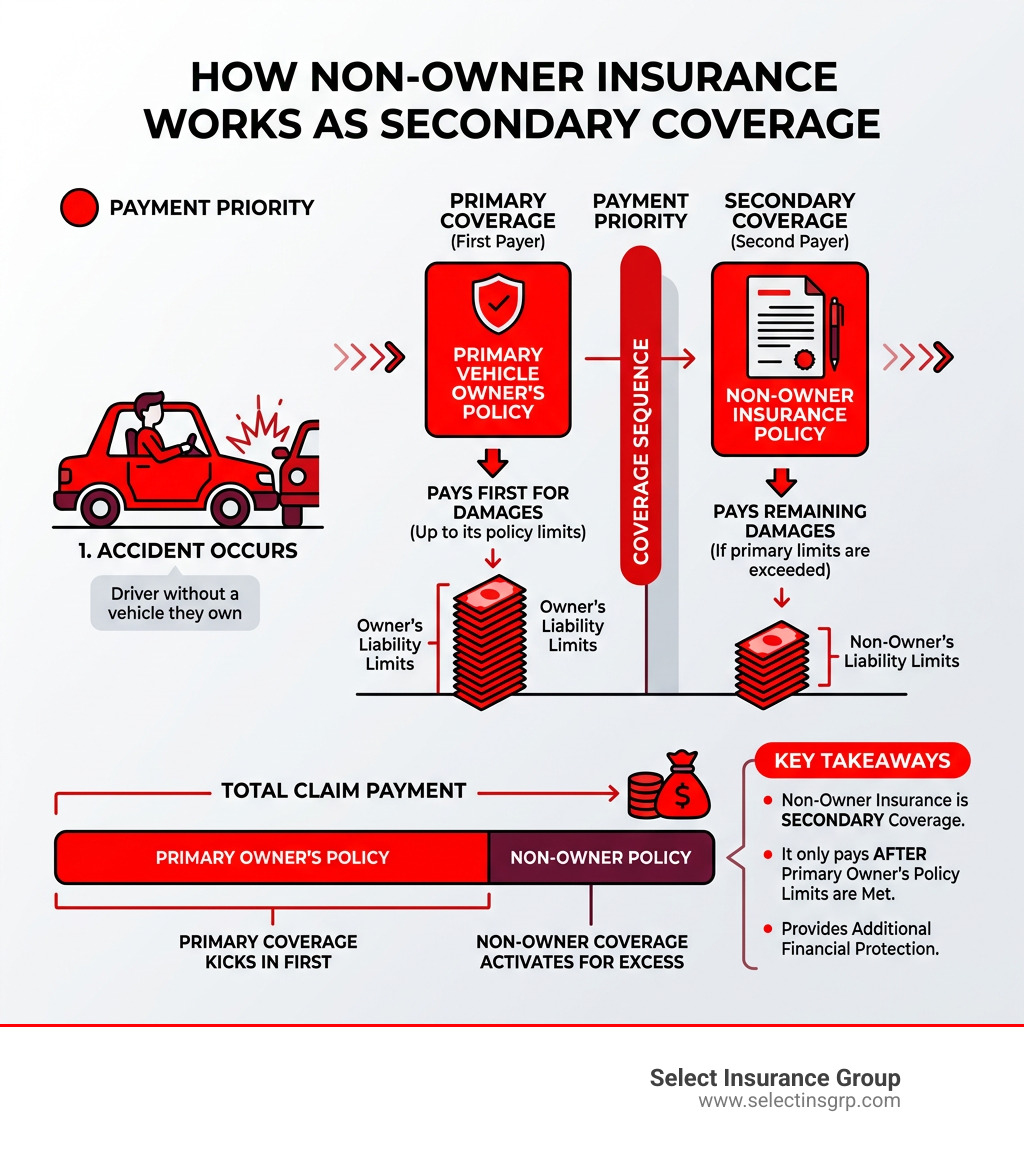
Think of it as “Personal Mobility Insurance.” It’s a safety net that travels with you, whether you are borrowing a friend’s SUV to move a couch or renting a sedan for a weekend getaway in Charleston. It provides secondary coverage, meaning it kicks in after the vehicle owner’s primary insurance limits have been exhausted.
Defining Full Coverage Non Owners Insurance vs. Liability
The primary difference between a “bare bones” non-owner policy and full coverage non owners insurance lies in who is being protected.
- Liability-Only Non-Owner Insurance: This is the most basic level. It covers the other person. If you cause an accident, it pays for their medical bills (Bodily Injury) and their car repairs (Property Damage). It does nothing for you.
- Full Coverage Non-Owner Insurance: This expands the umbrella. We often recommend adding:
- Medical Payments (MedPay): Covers your medical expenses regardless of who caused the accident.
- Personal Injury Protection (PIP): Similar to MedPay but can also cover lost wages and essential services. This is especially relevant for our clients in Florida.
- Uninsured/Underinsured Motorist (UM/UIM): This is vital. If someone hits you while you’re driving a borrowed car and they don’t have insurance, this coverage pays for your injuries.
By Getting Insurance Without a Car that includes these extras, you are closing dangerous coverage gaps. Without UM/UIM, for example, you could be left with massive medical debt if an uninsured driver strikes you.
How Non-Owner Policies Interact with Primary Insurance
One of the most confusing aspects of these policies is the “order of operations” during a claim. In the insurance world, coverage generally follows the car first.
If you borrow a friend’s car with their permission (known as “permissive use”), their insurance policy is the primary payer. However, what happens if your friend only carries the state minimum of $25,000 in liability, but you cause an accident resulting in $50,000 of damage?
This is where your full coverage non owners insurance saves the day. It acts as “excess coverage.” Once your friend’s $25,000 is spent, your non-owner policy steps in to cover the remaining $25,000. Without it, the injured party could come after your personal assets—your savings, your future wages, or your home.
Furthermore, a non-owner policy often provides a legal defense. If you are sued following an accident, your insurance company will provide an attorney to represent you, which can save you thousands in legal fees alone. According to A Driver’s Guide to Non-Owner Car Insurance, this peace of mind is one of the primary reasons frequent drivers choose to carry their own policy.
Coverage Components and Incident Protection
What exactly happens when the “rubber meets the road”—or in this case, when the bumper meets another bumper? Full coverage non owners insurance provides a broad shield against various financial disasters.
- Bodily Injury to Others: If you are at fault in an accident, your policy pays for the other party’s hospital stays, surgeries, and rehabilitation.
- Property Damage: This isn’t just for cars. If you lose control of a borrowed truck and take out a neighbor’s expensive wrought-iron fence or a storefront, your property damage liability covers the repairs.
- Medical Bills and Lost Wages: If you have PIP or MedPay included in your “full coverage” package, you won’t have to worry about how to pay your own doctor if you’re sidelined after a crash.
- Pedestrian and Passenger Protection: Some advanced non-owner policies (sometimes called Personal Mobility Coverage) even protect you if you are a passenger in a rideshare or if you are hit by a car while walking or biking.
As noted by CNBC Select, these policies are particularly useful for those using car-sharing services like Zipcar or Turo. While these services often provide a baseline of insurance, the limits are frequently low. Your own policy ensures you have high-limit protection that matches your actual financial risk.
Limitations of Full Coverage Non Owners Insurance
We believe in total transparency at Select Insurance Group. While we advocate for the protection full coverage non owners insurance provides, you must understand what it cannot do. The word “full” can be misleading because it never includes physical damage coverage for the car you are currently driving.
If you are looking for a Getting Liability Insurance Without a Car Guide, the first thing to learn is the “Collision/Comprehensive Exclusion.”
- No Collision Coverage: If you crash a borrowed car, your non-owner policy will not pay to fix that car. The owner’s insurance must cover it, or you must pay out of pocket.
- No Comprehensive Coverage: If the borrowed car is stolen, keyed by vandals, or crushed by a falling tree while in your care, a non-owner policy provides zero reimbursement.
- No Personal Property: If your laptop or luggage is stolen from the backseat of a car you’re borrowing, auto insurance (owner or non-owner) typically won’t cover it. You would need a renters or homeowners policy for that.
- No Business Use: If you are using a non-owned car for commercial purposes—like delivering pizzas or driving for a delivery app—a personal non-owner policy will likely deny any claims.
Does full coverage non owners insurance cover rental car damage?
This is a million-dollar question for frequent travelers. When you stand at the rental counter, the agent will inevitably try to sell you a Collision Damage Waiver (CDW) or Loss Damage Waiver (LDW).
Your full coverage non owners insurance will provide liability (damage to others). However, it will not cover the damage to the rental car itself.
To protect the rental vehicle, you have three main options:
- The Rental Company’s CDW: Usually $10 to $30 per day. It’s expensive but offers the most “walk-away” protection.
- Credit Card Benefits: Many premium credit cards offer secondary (or sometimes primary) collision coverage for rentals if you pay for the full rental with that card.
- Owner’s Policy: If the car belongs to a friend, their collision coverage is the primary source of repair funds.
One hidden cost your non-owner policy won’t cover is “Loss of Use” fees. If you wreck a rental car and it sits in the shop for two weeks, the rental company will charge you for the revenue they lost while the car was off the road. Most non-owner policies do not cover these administrative fees.
Who Benefits Most and Cost Considerations
Who actually needs to call us for a non-owner quote? It’s a more diverse group than you might think.
| Driver Profile | Why They Need It |
|---|---|
| Frequent Renters | Avoids the $15/day liability charge at the rental counter. |
| Frequent Borrowers | Protects their assets if the owner’s limits are too low. |
| Between Cars | Maintains “continuous coverage” to keep future rates low. |
| High-Risk Drivers | Fulfills SR-22 requirements to get a license back without owning a car. |
| City Dwellers | Use car-sharing (Zipcar/Turo) but want higher liability limits. |
For many, the biggest draw is the “Continuous Coverage” aspect. If you drop your insurance entirely because you sold your car, insurance companies will view you as a “high-risk” applicant when you buy a new one six months later. Your rates could jump by 15% to 26% just for having that gap. A non-owner policy keeps your “insurance resume” clean and active.
If you are in a situation where you are Getting SR22 Insurance Without a Car, a non-owner policy is often the only way to satisfy the state’s requirement for a certificate of financial responsibility.
Cost Factors: The average cost of a non-owner policy is approximately $325 per year, though national averages for more robust coverage can hover around $748. At Select Insurance Group, we’ve seen policies for clean drivers as low as $202 per year.
Your specific price will depend on:
- Your Location: Florida and Georgia rates differ significantly from rural Virginia.
- Driving History: A DUI or multiple speeding tickets will increase the premium.
- Coverage Limits: Choosing 100/300/50 limits will cost more than state minimums but offers vastly superior protection.
Frequently Asked Questions about Non-Owner Policies
How much does non-owner insurance cost on average?
As mentioned, the “sweet spot” for many drivers is around $325 annually. This breaks down to less than $30 a month. Compare that to the $10-$15 per day rental companies charge for liability, and the policy pays for itself in just three days of renting a car per year.
Can I get non-owner insurance if I have a car in my household?
This is a major sticking point. Most insurance companies will not sell you a non-owner policy if you have regular access to a vehicle in your household (e.g., a spouse’s car or a roommate’s truck). In these cases, the insurer expects you to be added as a “listed driver” on that vehicle’s primary policy. Non-owner insurance is strictly for those who do not have a car available for regular use.
Does this policy satisfy SR-22 requirements?
Yes. If the DMV has told you that you need an SR-22 (or an FR-44 in Florida/Virginia) to reinstate your license, but you don’t own a car, a non-owner policy is the standard solution. It proves to the state that you are carrying the required liability insurance whenever you get behind the wheel.
Conclusion
Navigating full coverage non owners insurance doesn’t have to be a headache. Whether you’re a city dweller relying on car-sharing, a frequent traveler, or someone working hard to get their license back, having the right protection is about more than just following the law—it’s about protecting your financial future.
At Select Insurance Group, we specialize in these “non-standard” situations. With over 30 years of experience, we don’t just give you a quote; we shop over 40 different carriers to find the one that fits your specific needs and budget in Florida, Georgia, Virginia, and the Carolinas.
Don’t leave your savings at risk every time you borrow a set of keys. Let us help you find a policy that offers peace of mind at a price you can afford. For More info about North Carolina auto insurance services or to get a quote in any of our licensed states, reach out to our team today. We’re here to help you stay covered, no matter whose car you’re driving.