
Why Understanding Florida Workers Comp Cost Matters for Your Business
Florida workers comp cost is a significant expense for any business with employees, but it’s also highly variable and often misunderstood. Here’s what you need to know:
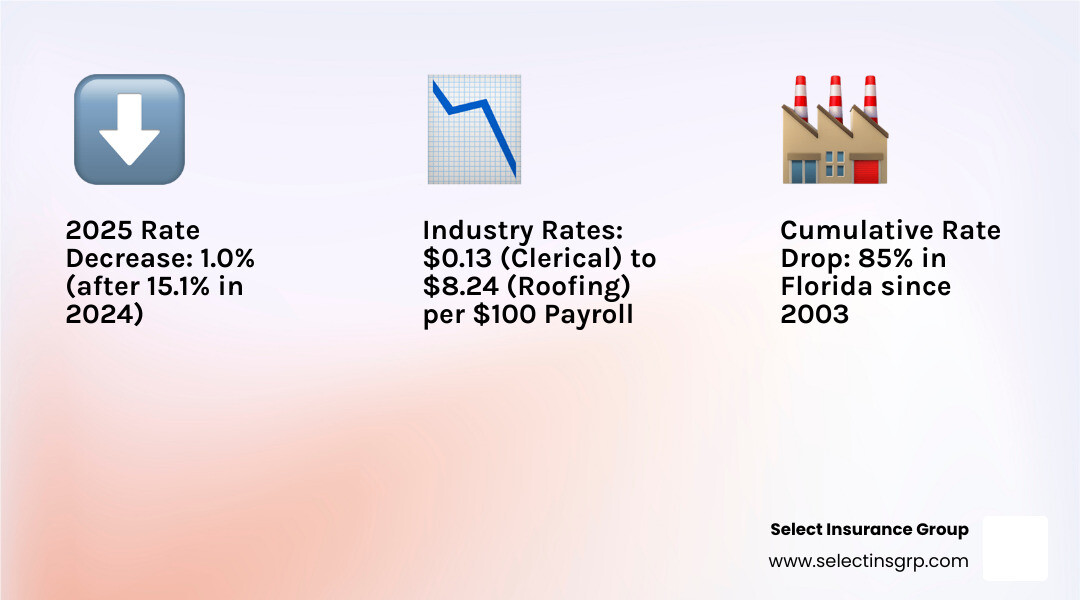
- 2025 Rates: Florida approved a 1.0% decrease in workers’ compensation rates for 2025, following a substantial 15.1% decrease in 2024
- Average Cost: Rates are quoted per $100 of payroll and vary dramatically by industry—from as low as $0.13 for clerical workers to $8.24 for roofing workers
- Long-Term Trend: Since 2003, Florida’s overall workers’ comp rates have dropped by a cumulative 85%, making the state more competitive
- 2026 Outlook: The National Council on Compensation Insurance (NCCI) has recommended a 6.9% average rate decrease for 2026
Your actual premium depends on several factors: your industry classification code, total payroll, claims history, and safety record. The formula is straightforward—your annual payroll divided by $100, then multiplied by your industry’s rate—but the final cost can be significantly influenced by your company’s Experience Modification Rate (EMR).
Florida businesses face unique challenges when it comes to workers’ compensation. The state requires coverage for most employers with four or more employees (and just one for construction companies), making compliance essential. Recent legislative changes, particularly Senate Bill 362 which raised physician reimbursement rates from 110% to 175% of Medicare levels, have impacted the overall cost structure. While this increase added approximately 5.6% to system costs, continued improvements in workplace safety and declining claim frequency have kept overall rates on a downward trajectory.
Understanding your Florida workers comp cost isn’t just about compliance—it’s about protecting your business from potentially devastating financial liability while managing one of your most significant operating expenses. With the right strategies, from implementing safety programs to accurately classifying employees, you can substantially reduce your premiums.
I’m D.J. Hearsey, founder and CEO of Select Insurance Group, and I’ve spent over three decades helping businesses across the Southeast steer complex insurance markets, including finding competitive Florida workers comp cost solutions. My experience working with 40+ carriers has given me insight into what truly drives these costs and how businesses can manage them effectively.
Understanding How Florida Workers’ Compensation Rates Are Determined
Ever wondered how those workers’ comp rates magically appear? It’s less magic and more a methodical process involving data, risk assessment, and regulatory oversight. In Florida, this process is largely influenced by the National Council on Compensation Insurance (NCCI). NCCI acts as a licensed rating organization, collecting detailed data on workplace injuries, claims, and payroll from insurance carriers across the state. They then use this data to recommend advisory rates and loss costs to the Florida Office of Insurance Regulation (OIR).
The Florida OIR, after reviewing NCCI’s recommendations and considering other factors like legislative changes (more on that later!), ultimately approves the rates. These approved rates then form the basis upon which insurance carriers develop the premiums they charge businesses like yours.
National Council on Compensation Insurance (NCCI).
The Core Formula for Calculating Your Premium
Understanding the general process is one thing, but calculating your estimated premium brings it closer to home. While carriers add their own expenses and profit margins, the fundamental calculation starts with this formula:
Estimated Annual Premium = (Total Annual Payroll / $100) x Class Code Rate x Experience Modification Rate (EMR)
Let’s break down these components:
- Total Annual Payroll: This is the total gross wages paid to your employees within a specific class code over a year. The more you pay your employees, the larger this number, and thus, potentially higher your premium.
- Class Code Rate: As we discussed, this is the NCCI-approved rate assigned to your specific type of work, expressed per $100 of payroll.
- Experience Modification Rate (EMR): This is where your business’s individual claims history comes into play. Your EMR, often called an “X-Mod” or “mod factor,” is a multiplier that adjusts your premium based on your actual loss experience compared to the average for businesses in your industry. An EMR below 1.0 means your claims experience is better than average, resulting in a credit (lower premium). An EMR above 1.0 means your claims experience is worse than average, leading to a debit (higher premium).
A good EMR can be a significant cost-saver, while a poor one can make your Florida workers comp cost skyrocket. You can learn more about how the EMR works here: Experience Modification Rate (EMR).
Key Factors That Influence Your Final Cost
While the formula provides the backbone, several other factors can significantly sway your actual Florida workers comp cost:
- Industry Risk: This is the fundamental driver. An accounting firm will inherently have lower workers’ comp costs than a roofing company because the risk of workplace injury is vastly different. The class code assigned to your business directly reflects this risk.
- Payroll Size: Larger payrolls generally mean higher premiums, as the rate is applied per $100 of payroll.
- Claims History: This is directly tied to your EMR. A history of frequent or severe claims will increase your EMR, leading to higher premiums. Conversely, a clean claims record will result in a favorable EMR and lower costs. Managing claims quickly and efficiently is crucial here.
- Safety Programs: Implementing robust safety programs demonstrates a commitment to preventing injuries. This can lead to fewer claims, a better EMR, and potentially discounts from insurers. Many carriers look favorably on businesses that actively manage workplace safety.
- Subcontractor Usage: If your business uses subcontractors, their workers’ comp coverage can impact your policy. If a subcontractor doesn’t carry their own insurance, their employees might be considered your employees for workers’ comp purposes, potentially increasing your payroll and risk exposure. Always verify subcontractor coverage!
- Company Location: While Florida is a single state, specific geographic locations within Florida might have slightly different base rates or experience different claim trends that could indirectly influence costs over time, though this is less impactful than other factors.
The Current State of Florida Workers Comp Cost in 2025
Florida businesses have seen a generally favorable trend in workers’ compensation rates over the past two decades. The state approved a 1.0% decrease in rates for 2025, following a substantial 15.1% decrease in 2024. This consistent decline means lower costs for many businesses, which is always welcome news!
In fact, since 2003, when Florida lawmakers made historic changes to the state’s workers’ compensation system, overall rates have fallen by a cumulative 85%. That’s a remarkable achievement that has made Florida a more attractive state for businesses to operate in.

However, it’s not always a straight line down. Recent legislative changes, specifically Florida Senate Bill (SB) 362, have introduced some upward pressure on overall system costs. This bill significantly raised reimbursement rates for worker-treating physicians, increasing them from 110% to 175% of Medicare’s reimbursement level. NCCI estimates that SB 362 will result in an impact of +5.6% on overall workers’ compensation system costs. Without this legislative change, the overall rate decrease for 2025 would have been closer to 6.4% instead of the approved 1.0%. It just goes to show how intertwined legislative decisions are with the final premiums businesses pay.
Average Florida workers comp cost by Industry
The average Florida workers comp cost can vary wildly depending on the industry and the specific job functions within that industry. This is because different jobs carry different levels of risk. To give you a clearer picture, here are some example class codes, job descriptions, and their approximate 2025 rates per $100 of payroll, based on NCCI data:
| Class Code | Job Description | 2025 Rate per $100 Payroll (approx.) | Risk Level |
|---|---|---|---|
| 8810 | Clerical Office Employees | $0.13 | Low |
| 9012 | Property Managers | $2.74 | Low-Medium |
| 8017 | Retail Store Employees | $1.179 | Low-Medium |
| 9082 | Restaurant NOC (Not Otherwise Classified) | $1.160 | Low-Medium |
| 5183 | Plumbing NOC and Drivers | $2.737 | Medium |
| 5190 | Electrical Wiring Within Building | $2.969 | Medium |
| 5213 | Concrete Construction NOC | $5.184 | High |
| 5551 | Roofing – All Kinds | $6.752 | Very High |
| 5645 | Carpentry – Detached Dwellings | $7.689 | Very High |
Note: These rates are examples and can vary slightly based on specific carrier pricing and other factors.
As you can see, the difference is stark. Clerical workers, with a rate of just $0.13 per $100 of payroll, represent one of the lowest-risk categories. A property manager, at $2.74, has a moderate risk due to potential property visits and interactions. On the other hand, roofing workers, facing significant hazards like falls and heavy lifting, have a much higher rate at $8.24 per $100 of payroll. This dramatically impacts the overall Florida workers comp cost for businesses in these sectors.
For example, if a clerical worker earns $40,000 annually, their estimated annual workers’ comp cost would be around $52. A property manager earning $58,000 might see costs around $1,589. But a roofer earning $42,000 could incur an annual cost of approximately $3,460. These figures highlight why understanding your specific class codes is so vital.
Looking Ahead: What to Expect for 2026 and Beyond
The good news continues for Florida businesses looking at their workers’ comp expenses. The NCCI has recommended an average rate decrease of 6.9% for the voluntary market, effective January 1, 2026. This would mark the ninth consecutive year of rate reductions in Florida!
This positive trend is largely attributed to a continued decline in lost-time claim frequency across the state, which NCCI attributes to safer workplaces and ongoing efforts in injury prevention. While the frequency of claims is down, the severity of claims (the cost per claim) has seen some increases, particularly for medical and wage replacement components. Medical cost increases are partly driven by increased utilization of services by injured workers, and indemnity benefits (wage replacement) are influenced by wage inflation. The average weekly wage in Florida, for instance, increased by 15% from 2021 to 2023, directly impacting the maximum weekly indemnity benefit for injured workers.
Despite these upward pressures on claim severity, the overall picture remains positive due to the significant reduction in claim frequency. The workers’ compensation system nationwide continues to demonstrate profitability, with a combined ratio for U.S. comp insurers reported at 86% in 2024, indicating a healthy market.
Navigating these rate changes and understanding their implications for your business requires vigilance. As an independent agency, we help our clients stay informed about these trends and how they might affect their overall Florida Commercial Insurance portfolio.
How Florida’s System Compares and Key Legal Requirements
It’s always helpful to see how Florida stacks up against other states when it comes to Florida workers comp cost. According to NCCI data, Florida ranked 30th (or 10th from the bottom) nationally in the cost of workers’ compensation insurance for employers. This position indicates that Florida is generally a more affordable state for workers’ comp compared to many others. For context, states like South Carolina average $1.60 for every $100 of payroll, which is lower than some of Florida’s higher-risk categories but comparable to many of its medium-risk ones.
Coverage Requirements and Exemptions
Florida’s workers’ compensation laws mandate coverage for most employers, but there are specific rules:
- General Businesses: Employers with four or more employees, full-time or part-time, are required to carry workers’ compensation insurance.
- Construction Industry: This industry has stricter rules. Any employer in construction must carry workers’ compensation insurance if they have one or more employees, including themselves if they are an officer of a corporation.
- Agricultural Industry: Employers with five or more regular employees and/or twelve or more seasonal employees who work for more than 30 days are required to have coverage.
Understanding these thresholds is critical for compliance.
Exemptions
While most businesses need coverage, certain individuals or entities might be exempt:
- Corporate Officers: In Florida, corporate officers can elect to exempt themselves from coverage. This can be a strategy to manage the overall Florida workers comp cost, but there are limits on how many officers can be exempt, especially in the construction industry. For example, in construction, only up to three corporate officers can exempt themselves.
- Sole Proprietors and Partners: These individuals are generally not considered employees and are typically exempt, though they can elect to be covered.
- Independent Contractors: Properly classified independent contractors are not subject to workers’ comp requirements. However, misclassifying an employee as an independent contractor can lead to severe penalties.
Penalties for Non-Compliance
Ignoring Florida’s workers’ compensation laws is a serious offense with significant repercussions. The Division of Workers’ Compensation has the authority to issue a Stop-Work Order, which immediately halts all business operations until compliance is met. Imagine the impact on your business if you had to shut down overnight!
Beyond a Stop-Work Order, you will face substantial financial penalties. These typically amount to double what your premium would have been for the entire period of non-compliance. This can quickly add up to tens of thousands of dollars, far exceeding the cost of obtaining proper coverage in the first place. Additionally, you could be held personally liable for any medical expenses and lost wages if an uninsured employee gets injured on the job.
For official information and assistance, the FL Division of Workers Compensation is an invaluable resource.
Actionable Strategies to Reduce Your Workers’ Comp Premiums
Managing your Florida workers comp cost isn’t just about accepting the rates set by the state; it’s about actively implementing strategies to reduce your premiums. We’ve seen countless businesses save significant amounts by taking a proactive approach.
These proactive measures focus on controlling costs and reducing risk, ultimately leading to lower premiums. Think of it this way: the safer your workplace and the better you manage claims, the less risk you present to an insurer, and the more likely they are to offer you better rates.
Implementing a Robust Safety Program
A strong safety program is your first line of defense against high workers’ comp costs. It’s not just about compliance; it’s about creating a culture where safety is paramount.
- Safety Training: Regular, comprehensive safety training for all employees is essential. This includes general workplace safety, equipment-specific training, and hazard recognition.
- Regular Inspections: Routinely inspect your workplace for potential hazards. This could involve daily checks of machinery, weekly walkthroughs of the premises, or monthly reviews of safety protocols.
- Proper Equipment: Ensure all employees have and use the correct personal protective equipment (PPE) for their tasks. Maintain all machinery and equipment to prevent malfunctions.
- Clear Safety Protocols: Establish clear, written safety procedures for every task, especially those involving higher risk. Make sure these are easily accessible and understood by all employees.
- Hazard Communication: Clearly label hazardous materials and communicate risks associated with specific job functions.
A safer workplace means fewer injuries, fewer claims, and ultimately, a lower EMR and lower premiums. It’s a win-win for everyone involved.
Managing Claims and Fostering a Return-to-Work Culture
Even with the best safety program, accidents can happen. How you manage claims and support injured employees can significantly impact your Florida workers comp cost.
- Prompt Claim Reporting: Report all workplace injuries to your insurance carrier immediately. Delays can complicate claims, increase costs, and potentially lead to disputes.
- Return-to-Work Programs: Implement a formal return-to-work (RTW) program. This involves bringing injured employees back to work in a modified capacity as soon as medically feasible. Studies show that employees who return to work quickly, even with light duties, recover faster and are less likely to pursue long-term disability.
- Light-Duty Options: Have a plan for light-duty assignments that accommodate an injured employee’s restrictions. This keeps them engaged, productive, and reduces the duration of lost-wage benefits.
- Claims Management: Actively manage claims by communicating with your injured employee, their medical providers, and your insurance carrier. Staying involved ensures that treatment is appropriate and that the claim progresses efficiently.
Ensuring Accuracy and Finding the Best Rates
Beyond safety and claims management, administrative accuracy and smart shopping are key to controlling your Florida workers comp cost.
- Accurate Payroll Reporting: Your premium is based on payroll, so accurate reporting is crucial. Overstating payroll means you’re overpaying for insurance. Understating it can lead to penalties and audits. Conduct regular payroll audits to ensure accuracy.
- Correct Class Code Assignment: This is paramount. An incorrect class code can drastically inflate your premiums. For instance, if you have office staff but they are incorrectly classified under a higher-risk construction code, you’ll pay much more than necessary. Work with your agent to ensure every employee is assigned the correct NCCI class code.
- Shopping the Market: Don’t just renew with your current carrier without exploring other options. The workers’ comp market is competitive, and rates can vary significantly between insurers, even for the same class codes and EMR.
- Independent Agent Benefits: This is where we come in. As an independent agency, Select Insurance Group isn’t tied to a single insurance carrier. We have relationships with over 40 carriers, allowing us to shop the market on your behalf to find the most competitive rates and comprehensive coverage for your business. We understand the nuances of Florida General Liability and workers’ comp, ensuring you get the best value.
Frequently Asked Questions about Florida Workers’ Comp Costs
How is my Experience Modification Rate (EMR) calculated?
Your Experience Modification Rate (EMR) is a crucial factor that directly impacts your Florida workers comp cost. It’s a multiplier designed to compare your company’s actual claims history to the average claims history of other businesses in your industry. NCCI collects three years of claims and payroll data for your business, excluding the most recent year. This data is then used in a complex formula that considers:
- Your actual losses: The total cost of your workers’ comp claims over the three-year period.
- Your expected losses: What NCCI predicts your losses should be based on your industry, payroll, and class codes.
The EMR is typically calculated annually. If your actual losses are lower than expected, your EMR will be below 1.0 (e.g., 0.85), resulting in a credit that lowers your premium. If your actual losses are higher than expected, your EMR will be above 1.0 (e.g., 1.20), resulting in a debit that increases your premium. Small, frequent claims can sometimes have a disproportionately negative impact on your EMR compared to a single large claim, due to how the formula weights different types of losses.
What happens if I don’t carry required workers’ comp insurance in Florida?
Failing to carry mandatory workers’ compensation insurance in Florida is a grave mistake that can lead to severe consequences. The Florida Division of Workers’ Compensation actively enforces these requirements.
The most immediate and impactful penalty is often a Stop-Work Order. This order legally compels your business to cease all operations immediately. Imagine the financial devastation of having your doors suddenly closed, unable to generate revenue, fulfill orders, or pay employees.
In addition to a Stop-Work Order, your business will face significant financial penalties. Typically, you will be assessed a penalty equal to double the amount of premium you would have paid had you been properly insured for the entire period of non-compliance. This can accumulate rapidly, especially for businesses with substantial payrolls. Furthermore, if an uninsured employee suffers a workplace injury, you, as the employer, will be held personally responsible for all medical expenses, lost wages, and any other benefits the injured worker is entitled to under Florida law. This financial burden can be catastrophic for a business.
Are owners and officers automatically included in coverage?
In Florida, the rules regarding the inclusion of owners and officers in workers’ compensation coverage depend on the business structure and the industry.
- Sole Proprietors and Partners: These individuals are generally not automatically covered and are considered exempt. However, they can elect to be included in coverage if they wish.
- Corporate Officers: This is where it gets a bit more nuanced. Corporate officers in Florida can, in many cases, elect to exempt themselves from workers’ compensation coverage. This can be a strategic decision to manage the overall Florida workers comp cost, particularly for small businesses where officers may not be actively involved in high-risk tasks. However, there are limitations:
- Construction Industry: In the construction industry, a maximum of three corporate officers can exempt themselves from coverage. All other officers must be covered.
- Non-Construction Industries: Generally, a greater number of officers may be exempt, but it’s crucial to understand the specific rules and file the correct exemption paperwork with the state.
It’s essential to consult with your insurance agent or the Florida Division of Workers’ Compensation to ensure you are compliant and have made informed decisions regarding owner and officer exemptions. Misunderstanding these rules could lead to unintended coverage gaps or penalties.
Conclusion
Navigating the complexities of Florida workers comp cost can seem daunting, but with the right knowledge and proactive strategies, it’s entirely manageable. We’ve seen that while legislative changes and economic factors like wage inflation can influence rates, the long-term trend in Florida has been favorable, with significant decreases over the past two decades.
Key takeaways for your business include:
- Understanding the Drivers: Your industry’s risk (class code), payroll, and especially your claims history (EMR) are the primary determinants of your premium.
- Proactive Management: Implementing robust safety programs and effectively managing claims, including fostering a return-to-work culture, are powerful tools to keep your EMR low and your premiums down.
- Strategic Shopping: Don’t settle for the first quote. The market is competitive, and working with an independent agency allows you to compare options from multiple carriers to find the best rates.
- Compliance is Key: Florida’s workers’ comp laws carry serious penalties for non-compliance, making adherence non-negotiable.
As an independent agency, Select Insurance Group helps Florida businesses steer the complexities of workers’ comp and find competitive rates from over 40 carriers. Our three decades of experience mean we understand the market, the regulations, and most importantly, how to tailor solutions that fit your unique business needs. We’re here to make sure your Florida workers comp cost is as efficient and fair as possible.
Ready to find the right coverage at the best price? Explore your options for Florida Commercial Insurance and get a personalized quote today.