
Why Choosing the Right Insurance Agent Matters
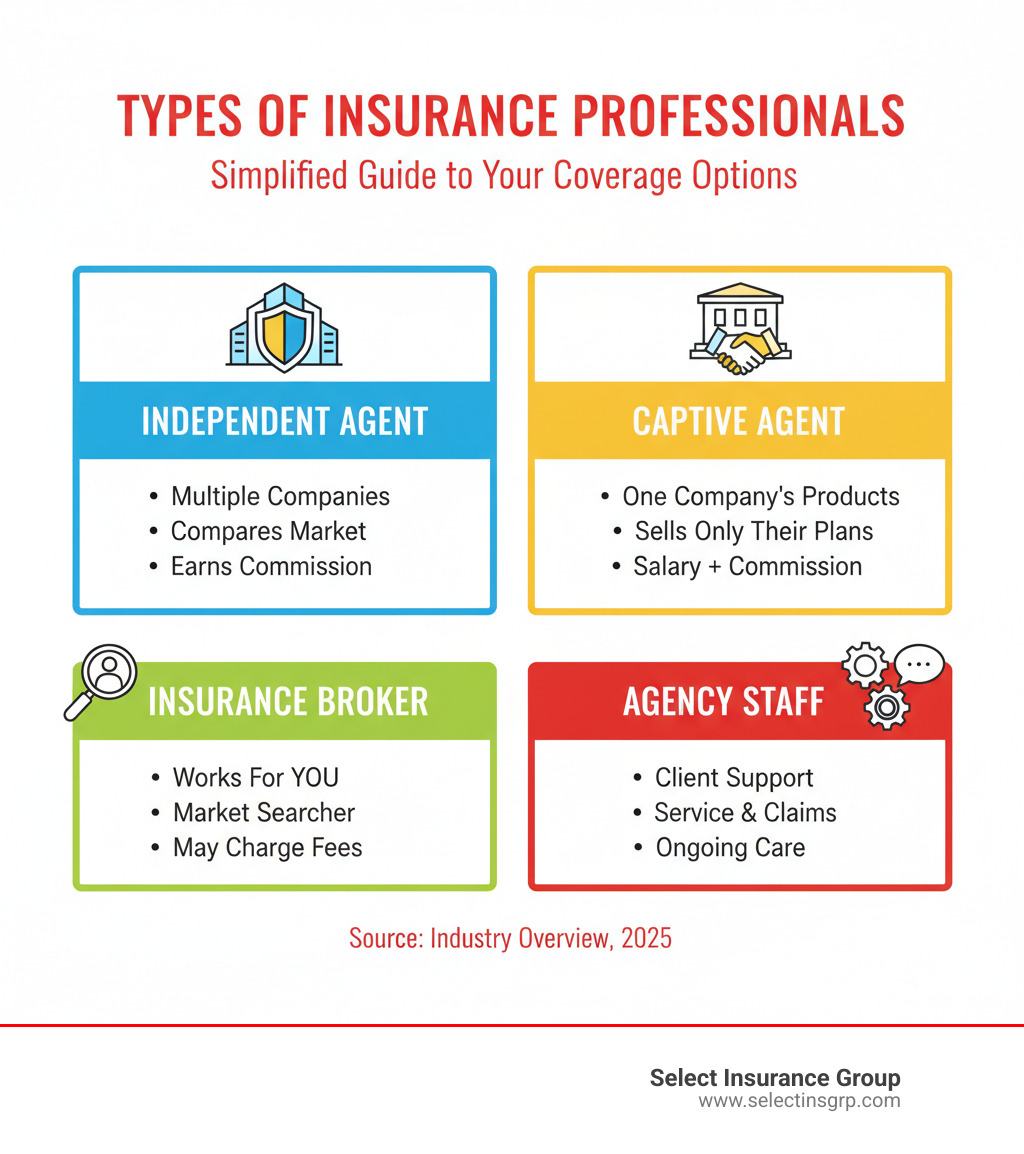
An insurance agent is a licensed professional who helps you find and manage insurance policies. They can be independent agents who represent multiple companies, captive agents who work for a single insurer, or insurance brokers who work directly for you. Most earn commissions and provide ongoing service for claims and policy updates.
Quick Answer: What You Need to Know About Insurance Agents
- Independent agents offer choices from multiple carriers and act as your advocate.
- Captive agents sell policies from only one insurance company.
- Licensing is required in every state; always verify credentials.
- Check their license through your state’s insurance department or the NAIC database.
- Watch for red flags like high-pressure tactics or unusually low prices.
Choosing an insurance policy isn’t just about price. It’s about finding a trusted advisor who will answer the phone when you have a claim, understand your needs, and review your coverage annually.
While you can buy insurance online in minutes, technology can’t replace a real person when disaster strikes. Whether it’s a car accident or a house fire, you want an expert in your corner to guide you through the claims process.
Not all agents are the same. Some represent one company, while others shop over 20 carriers to find the best combination of price and coverage. As D.J. Hearsey, founder of Select Insurance Group, I’ve spent over three decades helping clients find exceptional agents. My team works with multiple carriers to ensure our clients get real choices, not just a sales pitch.
Insurance agent definitions:
Understanding the Players: Types of Insurance Professionals
When shopping for insurance, you’ll encounter different professionals. Understanding their roles and loyalties is key to making a smart choice about who to trust with your coverage.

- Independent agents represent multiple insurance companies, allowing them to shop for the best combination of price and coverage on your behalf.
- Captive agents work for a single insurance company and can only offer that company’s products.
- Insurance brokers work directly for you, the client, to find custom solutions, often for complex needs.
- Agency staff members are the customer service backbone, helping with policy adjustments, claims questions, and daily service.
At Select Insurance Group, we operate as independent agents. With access to over 40 carriers, we shop the market to find coverage that fits your specific situation.
| Feature | Independent Agent | Captive Agent | Insurance Broker | Agency Staff Member |
|---|---|---|---|---|
| Represents | Multiple insurance companies | A single insurance company | The client (you) | The insurance agency |
| Product Offering | Broad choice from many carriers | Limited to one company’s products | Searches market for best fit | Supports agents, handles service |
| Loyalty | To the client (by finding the best fit) | To the insurance company | To the client | To the agency and its clients |
| Compensation | Commissions from insurers | Salary plus commissions | Client fee or commissions | Salary |
| Advantage for Client | More options, competitive pricing, advocacy | Deep expertise in one company’s products | Client advocacy, custom solutions | Responsive service, claims assistance |
| Disadvantage | May not be an expert in every single product | Limited options, may not offer the best rate | May charge a fee | Primarily support, not sales |
What is an Independent Insurance Agent?
An independent insurance agent is your advocate in the insurance marketplace. Because we aren’t tied to one company, we can represent multiple carriers and shop around to find you the best deal. We act as your personal value-hunter, comparing policies from dozens of insurers to find the right fit for your unique situation.
This is crucial when your needs change or rates increase. An independent agent can explore other options without you having to start over. During a claim, we’re in your corner, advocating for fair treatment because our loyalty is to you, not a single company’s bottom line. At Select Insurance Group, our relationships with over 40 carriers give our clients genuine choice. Learn more info about our agency.
What is an Agency Staff Member?
Agency staff members are the heroes of day-to-day insurance service. They work within the agency to support agents and clients, ensuring your experience is hassle-free after you buy a policy.
They handle crucial tasks like updating your address, adding a new vehicle, or answering questions about your renewal. During the claims process, they act as a liaison, answering your questions and explaining each step. They are the friendly, reliable support system that makes insurance manageable. At Select Insurance Group, our staff provides the personalized attention and superior service we’ve built our reputation on.
The Path to the Profession: How to Become an Insurance Agent
Becoming an insurance agent requires more than a friendly personality; it’s a career that blends sales with financial expertise, built on a foundation of formal training and licensing.

The journey typically starts with a high school diploma, though many employers prefer a bachelor’s degree in business or finance. New agents undergo on-the-job training for several months, learning about products, sales techniques, and compliance.
The most critical step is licensing. Aspiring agents must complete pre-licensing education and pass state-specific exams. Separate licenses are often required for different insurance types, such as Life and Health or Property and Casualty. A criminal background check is also mandatory. To maintain their license, agents must complete ongoing continuing education to stay current with new regulations and products.
Beyond formal requirements, successful agents possess key qualities:
- Analytical skills to assess a client’s needs and recommend appropriate coverage.
- Communication skills to explain complex policies in simple terms.
- Initiative and interpersonal skills to build relationships and connect with clients.
- Ethical conduct to always prioritize the client’s best interest.
For more details, the Occupational Outlook Handbook is an excellent resource.
Compensation and Career Outlook
According to the Bureau of Labor Statistics, the median annual wage for insurance sales agents was $60,370 in May 2024. Earnings can range from under $36,390 to over $135,660, as compensation is often a mix of salary, commissions, and bonuses. Income is heavily influenced by experience, sales performance, and the type of insurance sold.
Independent agents often earn primarily through commissions but benefit from higher rates and renewal income across multiple carriers, offering a higher reward potential. The job outlook is stable, with employment projected to grow 4 percent from 2024 to 2034, resulting in about 47,000 openings each year. Demand is driven by economic growth, an aging population, and the complexity of insurance products, which makes professional advice valuable. Growth is expected to be strongest for independent sales agents.
Career advancement can lead to specialization, agency management, or opening an independent agency. With more certifications, agents can also move into financial planning, underwriting, or claims adjustment.
Primary Duties and Daily Work Environment
The daily work of an insurance agent is varied. Key duties include:
- Client Prospecting: Finding new clients through networking and referrals.
- Needs Analysis: Interviewing clients to understand their financial situation and coverage needs.
- Policy Customization: Explaining policy options and tailoring programs to fit individual clients.
- Policy Management: Handling sales, renewals, and modifications.
- Claims Assistance: Guiding clients through the claims process.
Most agents work in an office but also meet with clients at their homes or businesses. The standard work week is 35-40 hours, but evening and weekend appointments are common to accommodate clients. The work is dynamic, involving everything from helping a young couple insure their first home to advising a business owner on liability risks.
Your Ultimate Checklist: How to Find and Choose the Right Insurance Agent
Finding the right insurance agent is about building a relationship with a trusted advisor who will be there when you need them most. This checklist will help you find an agent who truly has your back.

How to Find a Reputable Agent
- Ask for referrals: Start with people you trust, like friends, family, and colleagues. Ask about their agent’s responsiveness and claims support.
- Check online reviews: Use sites like Google and Yelp to look for patterns in customer feedback. Focus on the overall trend, not just outlier reviews.
- Use professional networks: Directories from organizations like the IIABA or NAIFA list licensed professionals committed to ethical conduct. You can also Find an agent in your area through specialized locators.
Vetting Your Potential Insurance Agent
Once you have a few candidates, do your homework.
- Verify their license: This is non-negotiable. Use the NAIC Consumer Information Source (CIS) or your state insurance department’s website. This simple check protects you from fraud.
- Review their complaint history: The NAIC and your state department also track complaints. A pattern of unresolved issues is a major red flag. You can Contact your state insurance department for detailed records.
- Assess the insurance companies: An agent is only as good as the insurers they represent. Ask about the financial strength ratings from agencies like A.M. Best to ensure the company can pay claims.
- Ask about professional credentials: Designations like CLU or CPCU indicate advanced education. A good agent will explain how their expertise benefits you.
Red Flags to Watch Out For
Trust your instincts and be wary of these warning signs:
- High-pressure sales tactics: A good agent gives you time to think. If you feel rushed, walk away.
- Prices that seem too good to be true: An unusually low quote may indicate inadequate coverage or a scam. Compare policies line by line.
- Requests to pay in cash or sign blank forms: Legitimate transactions are documented. Never sign an incomplete form or pay in cash without a proper receipt.
- Evasive or confusing answers: If an agent can’t clearly explain policy terms or their license status, find someone else.
- Poor responsiveness: If an agent is hard to reach before you’re a client, imagine how it will be when you have a claim.
The Modern Agent: Navigating Technology and Ethics
The insurance world has transformed dramatically, but technology hasn’t replaced the value of a human expert. A modern insurance agent leverages technology to improve service while upholding strict ethical standards.
Technology’s Impact on the Insurance Landscape
Online quote tools and digital policy management have made buying and managing insurance easier than ever. You can compare prices instantly and access your policy from your phone. Behind the scenes, AI helps insurers assess risk more accurately.
However, technology has its limits. An algorithm can’t offer empathy after a house fire or explain the nuances of a complex claim denial. When you’re protecting your family or business, you deserve more than a chatbot. We believe technology should improve the human connection, not replace it.
Ethical Considerations and Responsibilities
Insurance agents are licensed professionals with serious ethical duties:
- Act in your best interest: We must recommend policies that fit your needs, not just ones that pay high commissions.
- Be transparent: You have a right to understand what your policy covers, what it excludes, and how we are compensated.
- Be accurate and honest: Misrepresenting coverage is unethical and can have devastating consequences for clients.
- Maintain confidentiality: Your personal and financial information must be kept private.
- Pursue continuing education: We have an obligation to stay current on new products, risks, and regulations to serve you effectively.
How the Role Varies Across Insurance Types
An agent’s daily work varies by specialty:
- Property & Casualty agents focus on protecting physical assets (home, auto) and shielding you from liability lawsuits. They help you understand deductibles, limits, and endorsements.
- Business insurance agents handle complex commercial risks, including property damage, liability, workers’ compensation, and cyber threats. They perform detailed risk assessments for different industries.
- Life & Health agents deal with personal financial protection. They help clients with life insurance to protect their family’s future and steer the complexities of health, disability, and long-term care insurance.
How to Get the Most from Your Policy
Buying a policy is just the beginning. To maximize its value, treat your agent as a long-term resource.
- Schedule annual policy reviews: Life changes, and your insurance should too. A yearly check-in ensures you don’t have coverage gaps.
- Understand your coverage: Ask your agent to explain your policy in plain English. Know your deductibles, limits, and exclusions.
- Communicate proactively: Call your agent before a major purchase or renovation to understand any insurance implications.
- Use your agent as a resource: We can advise on risk mitigation, guide you through claims, and help you understand evolving coverage options. Don’t hesitate to Get a Quote or ask for a review.
Conclusion
Choosing the right insurance agent is a critical decision for your financial security. It’s about finding a trusted partner, not just buying a policy.
We’ve explored the different types of insurance professionals, the path to becoming an agent, and the tools you need to find a reputable one. The key is to verify their license, check their history, and watch for red flags like high-pressure tactics. While technology offers convenience, it can’t replace the personalized guidance of a human expert during a crisis.
The best agents act as your advocate, whether they’re helping you protect your home and car, plan for your family’s future with life insurance, or safeguard your business. They provide expert guidance, transparent advice, and unwavering support.
At Select Insurance Group, we’ve built our reputation over 30+ years on this philosophy. As independent agents, we work with over 40 carriers to give you real choices and competitive rates. We serve families and businesses across Florida, the Carolinas, Virginia, and Georgia, and we’re ready to be your long-term partner in protection.
Don’t settle for an agent who disappears after the sale. Choose a partner who will be there for the long haul. Ready to experience the difference? Find the right coverage with our Tampa insurance agency and let’s start a conversation today.